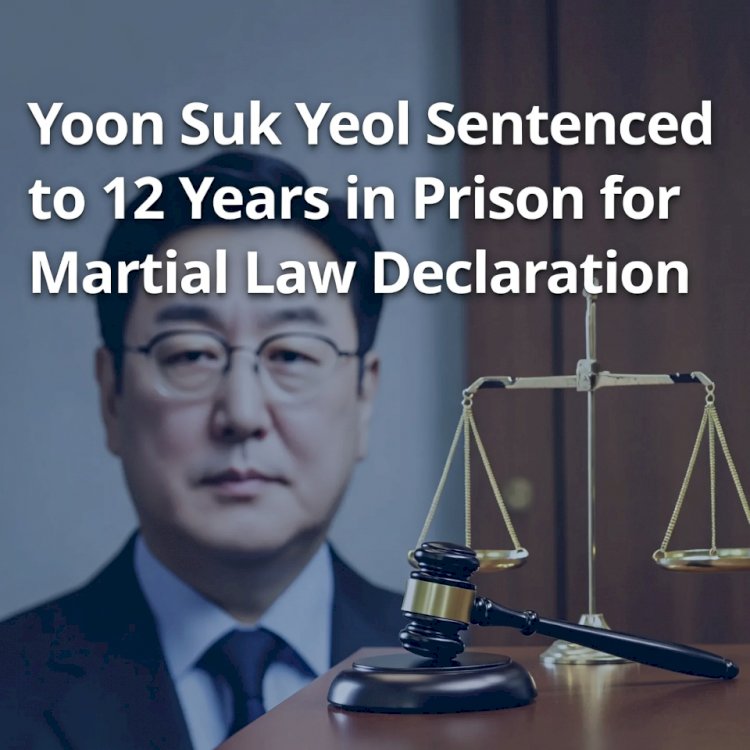
Yoon Suk Yeol Sentenced to 12 Years in Prison for Martial Law Declaration
 content-team
February 19, 2026
A Seoul Central District Court sentenced former South Korean President Yoon Suk Yeol to 12 years in prison today after finding him guilty of insurrection, abuse of power, and related charges stemming from his short-lived declaration of martial law on December 3, 2024. The court also imposed a 15-year political ban and ordered forfeiture of approximately 2.8 billion won ($2 million) in assets.
The three-judge panel ruled that Yoon’s martial law decree constituted an “illegal and unconstitutional act of insurrection” intended to suspend legislative functions and suppress political opposition. Presiding Judge Kim Se-yun stated that the former president “gravely violated the constitutional order and democratic principles” by mobilizing military forces against the National Assembly and attempting to arrest opposition lawmakers.
Yoon, who was impeached by the National Assembly on December 14, 2024 and removed from office by the Constitutional Court on March 24, 2025, has been in custody since his arrest on January 15, 2025. He appeared in court wearing a navy suit and maintained his innocence throughout the 14-month trial, claiming the martial law order was a “limited defensive measure” against alleged election fraud and North Korean threats.
Defense attorneys immediately announced plans to appeal the verdict to the Seoul High Court, calling the ruling “politically motivated” and arguing that the court improperly expanded the definition of insurrection. Prosecutors had sought a 20-year sentence and lifetime political ban.
Political and Social Fallout
The sentencing caps one of the most dramatic political crises in South Korean history. Yoon’s martial law declaration — which lasted only six hours before being overturned by the National Assembly — triggered mass protests, a parliamentary impeachment vote, and eventual removal from office.
Current President Lee Jae-myung, who defeated conservative candidate Kim Moon-soo in the May 2025 snap election, welcomed the verdict as “a reaffirmation of constitutional supremacy and democratic accountability.” Opposition People Power Party leaders condemned the sentence as “judicial revenge” and warned it could deepen national division.
Public opinion remains deeply polarized. A Gallup Korea poll released yesterday showed 58% of respondents supporting the guilty verdict while 37% viewed it as excessive or politically driven.
International reactions were muted but pointed. The United States State Department reiterated support for South Korea’s democratic institutions and rule of law. China’s Foreign Ministry avoided direct comment on the sentencing but called for “stability on the Korean Peninsula.”
Yoon will remain in Seoul Detention Center pending appeal proceedings. If the high court upholds the verdict, he will begin serving the sentence immediately, becoming the second former South Korean president imprisoned after conviction (following Park Geun-hye in 2018 and Lee Myung-bak in 2018).
The case continues to cast a long shadow over South Korean politics as the country approaches local elections in June 2026 and prepares for the next presidential race in 2027. Legal experts expect the appeals process to last 18–24 months, keeping the Yoon saga at the center of national debate.