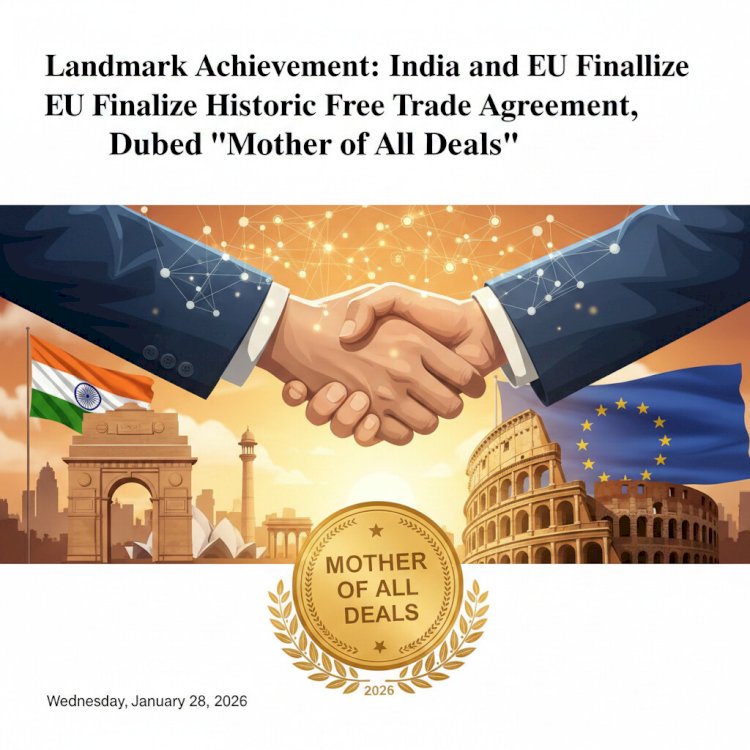
Landmark Achievement: India and EU Finalize Historic Free Trade Agreement, Dubbed 'Mother of All Deals'
 content-team
January 28, 2026
India and the European Union yesterday clinched a comprehensive free trade agreement after nearly two decades of negotiations, creating one of the world's largest economic partnerships and unlocking massive opportunities for businesses, consumers, and supply chains on both continents.
Summit Breakthrough in New Delhi
The deal was sealed during the 16th India-EU Summit held in New Delhi on January 27, where Prime Minister Narendra Modi welcomed European Commission President Ursula von der Leyen and European Council President Antonio Costa. After intense final rounds, both sides declared the text complete, describing the pact as a historic milestone that unites two major democracies representing nearly two billion people and a quarter of global GDP.
Von der Leyen called it a day of making history, stating the agreement would create the largest free trade zone on Earth and deliver tangible benefits for citizens, workers, and companies. Modi hailed it as India's most significant trade deal ever, emphasizing that it goes far beyond tariffs to become a blueprint for shared prosperity, innovation, and resilient global supply chains.
Sweeping Concessions and Sectoral Gains
Under the agreement, India secures zero or significantly reduced duties on more than 99 percent of its current exports to the EU by value. Key beneficiary sectors include textiles and apparel, gems and jewellery, leather products, pharmaceuticals, processed foods, tea, coffee, spices, fresh fruits and vegetables, and marine products.
Commerce and Industry Minister Piyush Goyal projected that textile exports alone could jump from the current 7 billion dollars to 30-40 billion dollars annually, potentially generating 6 to 7 million new jobs in labor-intensive industries.
For the European side, the pact opens India's vast market with substantial tariff reductions on automobiles, wines and spirits, machinery, chemicals, dairy alternatives, and a wide range of services. European companies will gain improved access to government procurement, intellectual property protections, and investment safeguards, positioning them to capitalize on India's rapid economic growth.
India successfully protected sensitive agricultural sectors such as dairy, cereals, poultry, and certain horticultural products, ensuring domestic farmers remain shielded from import surges.
Strategic Timing Amid Global Trade Shifts
The agreement arrives at a moment of heightened trade uncertainty, with new tariff threats emerging from major economies and supply chains facing repeated disruptions. Leaders framed the deal as a powerful signal in favor of open, rules-based trade and strategic diversification away from over-reliance on single partners.
It complements India's recently concluded pacts with the United Kingdom and the European Free Trade Association, while strengthening Europe's footprint in one of the fastest-growing major markets.
Beyond trade, the summit produced additional accords on defense and security cooperation, counter-terrorism, maritime security in the Indo-Pacific, clean energy partnerships, digital connectivity, and joint development of military equipment.
Path to Entry into Force
The negotiated text now enters the legal scrubbing and translation phase. Formal signing is expected in approximately five to six months, followed by ratification processes in the European Parliament, approval by EU member states, and endorsement by India's cabinet and parliament.
Implementation could begin as early as late 2026 or early 2027, with phased tariff reductions and transitional arrangements to ease adjustment for affected industries.
Business and Analyst Reactions
Indian industry bodies welcomed the breakthrough as a game-changer that would boost exports, attract investment, and integrate Indian manufacturers deeper into global value chains. European business associations expressed optimism that reduced barriers would benefit consumers through lower prices and greater choice while giving EU firms a first-mover edge in India's expanding market.
Analysts predict bilateral trade could double within a decade, with significant gains in services, technology transfers, and sustainable development projects.
As the ink dries on what leaders have called the mother of all deals, attention now shifts to swift ratification and effective rollout. If implemented smoothly, this ambitious partnership has the potential to reshape global trade patterns, reinforce strategic ties between two of the world's largest democracies, and provide a stabilizing anchor in an era of economic fragmentation and geopolitical uncertainty.