
Power Play in Beijing: Xi Jinping's Inner Circle Rocked by Major Military Purge Amid Coup Speculation
 content-team
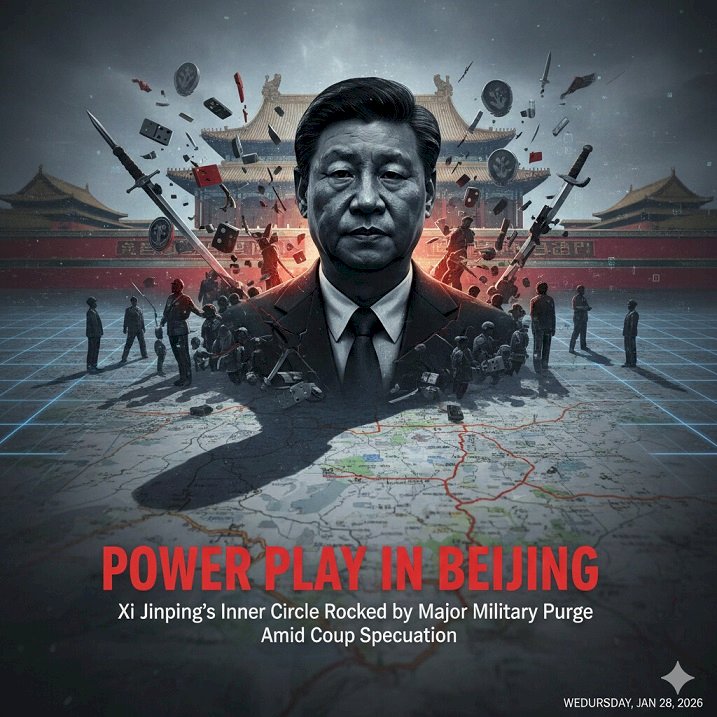
January 28, 2026
China's leadership has been thrown into turmoil with the dramatic investigation of its top general, fueling widespread rumors of a thwarted coup attempt against President Xi Jinping and marking one of the most significant military shakeups in decades.
Top Brass Targeted in Unprecedented Crackdown
China's Ministry of National Defense confirmed that General Zhang Youxia, vice chairman of the Central Military Commission and long considered Xi's closest military confidant, is under investigation for serious violations of discipline and law. General Liu Zhenli, chief of the Joint Staff Department, faces similar scrutiny.
The probe has effectively gutted the uniformed leadership of the Central Military Commission, leaving Xi and one remaining officer, General Zhang Shengmin, in charge of China's armed forces. Analysts describe the move as the most sweeping purge of senior military ranks since the Mao era, with several high-ranking figures already removed or sidelined in recent years.
Zhang Youxia, a 75-year-old veteran with combat experience and deep revolutionary family ties, had been viewed as politically untouchable. His downfall alongside Liu has stunned observers who saw him as a moderating influence on aggressive military postures, particularly regarding Taiwan.
Rumors of Coup Plot Swirl Online and Abroad
Unverified reports circulating on overseas Chinese platforms and exile sources claim the purge stems from a failed attempt to arrest Xi on January 18 at Beijing's Jingxi State Guesthouse. According to these accounts, conspirators planned to detain the president, but Xi received intelligence just hours before and escaped, triggering a violent confrontation and mass arrests.
Some narratives allege thousands of military personnel and relatives have been detained, with accusations ranging from corruption to leaking nuclear secrets to the United States and orchestrating factional rebellion. While mainstream Western outlets like Reuters, The New York Times, and Bloomberg report only the official corruption investigations, they note the opacity of Chinese politics leaves room for speculation about deeper power struggles or disloyalty.
No official Chinese statement has addressed coup allegations, with state media focusing narrowly on anti-corruption discipline enforcement and loyalty to the Party.
Strategic Fallout: Questions Over Military Readiness
The purge raises serious concerns about command cohesion in the People's Liberation Army at a time of heightened regional tensions. Experts warn that removing experienced leaders like Zhang, who had actual battlefield credentials, could disrupt modernization efforts and operational planning.
Some analysts suggest the timing diminishes prospects for near-term assertive action on Taiwan, as Xi prioritizes absolute loyalty over combat expertise. Others view it as a classic consolidation of personal power, ensuring no alternative centers of influence remain within the military.
Broader Implications in an Opaque System
Xi's anti-corruption campaign, ongoing since 2012, has targeted thousands across government and military ranks. This latest escalation into his innermost circle underscores that no one, not even sworn allies, is immune when loyalty is questioned.
As Beijing maintains tight control over information, the purge fuels global debate about stability within China's ruling elite. With the PLA now facing a leadership void and speculation running rampant, the coming months will reveal whether this marks the end of internal challenges or the beginning of further instability at the heart of Chinese power.
The world watches closely, as any cracks in Beijing's command structure could ripple across global security dynamics in an already tense geopolitical landscape.