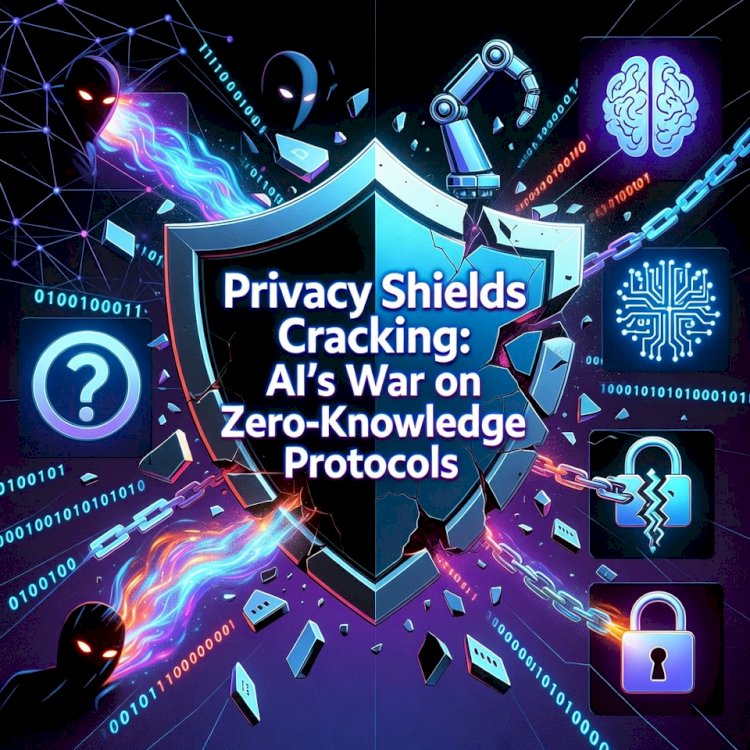
Privacy Shields Cracking: AI's War on Zero-Knowledge Protocols
 content-team
By Dr. Pooyan Ghamari Swiss Economist and Visionary
February 24 2026 marks a pivotal inflection point in the privacy arms race. Zero knowledge protocols once hailed as unbreakable guardians of data confidentiality now confront an unrelenting adversary in generative artificial intelligence. What protected identities transactions and computations in blockchain DeFi identity systems and beyond faces systematic erosion through intelligent probing optimization and exploitation.
The Fortress Of Zero Knowledge
Zero knowledge proofs allow one party to demonstrate the truth of a statement without revealing any underlying information. zk SNARKs zk STARKs PLONK and related systems power privacy coins shielded transactions verifiable computations and scalable layer two networks. They enable users to prove possession of funds compliance with rules or correct execution of smart contracts while keeping sensitive details hidden. This cryptographic magic underpins much of the privacy preserving infrastructure in decentralized finance anonymous credentials and confidential machine learning.
The Emergence Of AI As Cryptographic Adversary
Generative artificial intelligence shifts the battlefield dramatically. Large language models and reinforcement learning agents no longer merely generate text. They analyze circuit descriptions reverse engineer proof systems and propose novel side channel vectors. AI driven tools simulate millions of proof generations in parallel identifying patterns in trusted setups randomness leakage or implementation flaws that human auditors might overlook for years. Advanced agents craft adversarial inputs designed to force proof systems into revealing partial information through subtle soundness violations or zero knowledge compromises.
Targeted Assaults On Core Constructions
zk SNARKs with their trusted setup ceremonies remain particularly vulnerable. Generative models trained on vast repositories of cryptographic literature and codebases generate plausible toxic waste contributions that could undermine setup integrity if inserted undetected. Even transparent systems like zk STARKs face threats from AI accelerated collision searches or optimized algebraic attacks that reduce the computational hardness assumptions. In zero knowledge machine learning pipelines where proofs verify neural network inferences without exposing weights or inputs generative adversaries probe for information leakage by crafting model queries that elicit distinguishable proof behaviors.
The Hybrid Threat Landscape
The most potent danger arises from hybrid attacks combining generative AI with classical cryptanalysis. Reinforcement learning agents explore enormous search spaces pruning ineffective paths and focusing on promising weaknesses. When paired with access to cloud based quantum simulators these systems approximate future quantum advantages against lattice based or hash based primitives embedded in emerging zero knowledge constructions. Even without full scale quantum hardware AI narrows the gap accelerating discovery of practical breaks.
Economic And Systemic Consequences
Privacy shields cracking unleashes cascading effects across ecosystems. Shielded pools in privacy focused chains lose fungibility as transaction graphs become partially reconstructible. Confidential DeFi protocols expose user positions to targeted liquidation or front running. Decentralized identity systems reveal attributes users intended to keep private leading to discrimination or coercion. Verifiable computation markets see eroded trust forcing reliance on slower less private alternatives. Billions in locked value hang in the balance as protocols built on zero knowledge foundations confront sudden devaluation of their core security claims.
Signs Of The Cracking Already Visible
Recent analyses of deployed systems reveal subtle anomalies consistent with AI assisted probing. Proof verification times exhibit unnatural variances under certain adversarial workloads. Implementation repositories face floods of seemingly benign pull requests embedding micro optimizations that later prove exploitable. Governance discussions on major zero knowledge projects now routinely include AI generated counterarguments that mimic expert dissent while advancing weakening proposals.
Fortifying The Defenses
Countermeasures demand proactive evolution. Shift toward fully transparent post quantum resistant primitives even at the cost of larger proof sizes. Implement continuous adversarial training for proof generators incorporating generative models as red team opponents. Deploy multi party computation enhanced setups with verifiable distributed ceremonies. Foster standardized auditing frameworks that mandate AI stress testing before deployment. Layer zero knowledge with emerging verification techniques such as proof of training or verifiable execution traces to create defense in depth.
The Reckoning And The Reinvention
AI's war on zero knowledge protocols does not spell the end of privacy technology. It forces maturation. The shields crack under pressure yet resilient designs emerge stronger through relentless testing and adaptation. Protocols that survive this era will integrate artificial intelligence not as foe but as integral guardian continuously evolving against synthetic threats. The alternative invites catastrophe where privacy becomes performative illusion rather than cryptographic reality.
In this crucible of innovation versus subversion the future of confidential computation hangs in the balance. Those who treat generative AI as an existential adversary rather than a peripheral concern will rebuild privacy infrastructure capable of withstanding the onslaught. The war rages now. Victory demands vigilance innovation and the courage to question even the most cherished cryptographic assumptions. The cracked shields can be reforged but only through unflinching confrontation with the intelligence that seeks to shatter them.