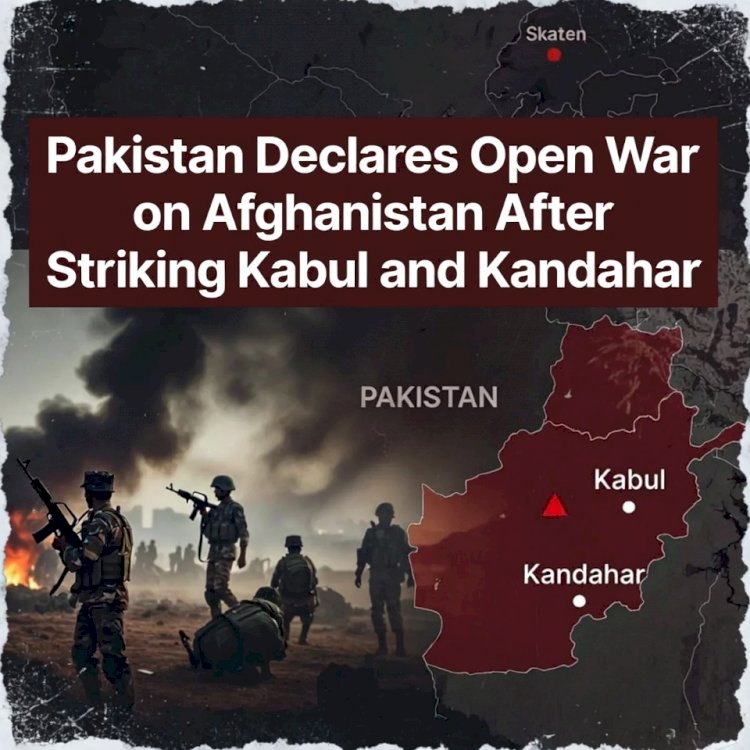
Pakistan Declares Open War on Afghanistan After Striking Kabul and Kandahar
 content-team
February 27, 2026
Explosions rocked Afghanistan's capital Kabul early Friday morning as Pakistani warplanes launched widespread airstrikes deep inside Afghan territory, marking a sharp escalation in the long-simmering border conflict between the two neighbors. Pakistan's defense minister swiftly declared the situation an "open war" with the Taliban government in Kabul, following retaliatory attacks from Afghan forces across the disputed Durand Line.
The strikes targeted multiple locations including Kabul, the southern city of Kandahar, and the southeastern province of Paktia. Pakistani military officials described the operation, named Ghazab Lil Haqq or Righteous Fury, as a direct response to Afghan cross-border assaults launched late Thursday night. Those Afghan attacks hit Pakistani military positions in the northwestern province of Khyber Pakhtunkhwa, prompting Islamabad to unleash what it called a comprehensive counteroffensive.
Escalation Rooted in Militant Safe Havens
Tensions had been building for months over Pakistan's accusations that the Taliban regime in Afghanistan provides sanctuary to Tehreek-e-Taliban Pakistan militants, known as TTP, who carry out deadly attacks inside Pakistan. Earlier this month, Pakistani airstrikes on February 22 hit alleged militant camps in eastern Afghan provinces such as Nangarhar, Paktika, and Khost. Afghan officials reported civilian deaths in those initial raids, with at least 18 people killed according to Kabul, while Pakistan claimed to have eliminated dozens of fighters.
The cycle intensified Thursday when Afghan forces initiated large-scale operations against Pakistani border posts, claiming retaliation for the earlier incursions. Pakistani authorities reported heavy fighting along several sections of the 2,600-kilometer frontier, with drone activity and artillery exchanges reported in multiple districts.
In response, the Pakistan Air Force conducted precision strikes on what it described as Afghan defense facilities and Taliban military targets. Officials in Islamabad claimed the operation hit more than 20 locations, resulting in significant casualties among Taliban fighters, with figures exceeding 200 killed and hundreds injured. Afghan spokespeople confirmed strikes in Kabul and Kandahar but disputed the casualty numbers, asserting that residential areas suffered damage and civilian lives were lost.
Conflicting Claims Amid Rising Casualties
Both sides issued starkly different accounts of the damage inflicted. Pakistan emphasized that its actions remained focused on military and militant infrastructure, avoiding broader civilian harm. Afghan Taliban representatives condemned the bombings as violations of sovereignty, reporting blasts in Kabul that sent plumes of smoke into the sky and triggered widespread alarm in the city. Witnesses described hearing jet engines overhead followed by multiple detonations, with ambulance sirens echoing through streets in the aftermath.
The strikes on Kandahar held particular symbolic weight, as the city serves as the spiritual and political heartland of the Taliban movement and the reported location of its supreme leader. This marked the first time Pakistani forces directly targeted such high-profile Afghan urban centers in the current round of hostilities.
Border crossings between the two countries remained shut, exacerbating humanitarian concerns in frontier regions already strained by years of instability. Local populations on both sides faced immediate disruptions, with reports of displaced families fleeing intensified shelling.
International Concern Over Regional Stability
The dramatic shift to open hostilities raised alarms about broader implications for South Asia. Previous border skirmishes had remained limited, but the inclusion of major cities signaled a new threshold. Pakistan's defense minister Khawaja Asif stated plainly that Islamabad's patience had ended, framing the conflict as unavoidable given ongoing threats from militants operating from Afghan soil.
Taliban officials indicated openness to negotiations despite the fresh violence, suggesting a potential path toward de-escalation even as fighting continued into Friday. Analysts noted that the porous border and mutual accusations of harboring insurgents have fueled recurring crises, with little progress in past diplomatic efforts.
As aircraft patrols reportedly lingered over Afghan airspace and ground clashes persisted along the frontier, the risk of further escalation loomed large. The coming days will test whether military pressure forces concessions or pushes the neighbors into a prolonged and destructive confrontation, with consequences that could ripple far beyond the rugged Durand Line.