
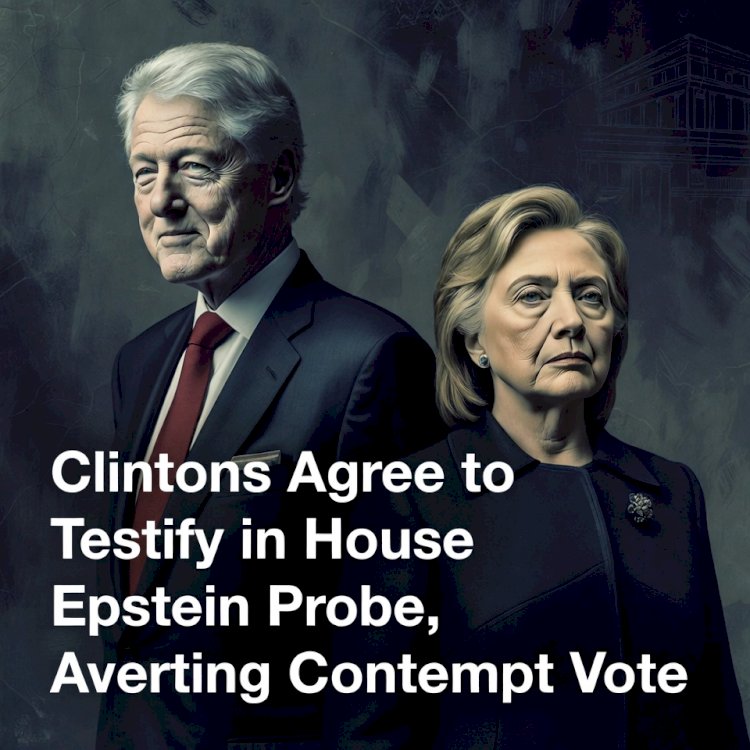
Clintons Agree to Testify in House Epstein Probe, Averting Contempt Vote
 content-team
February 04, 2026
Former President Bill Clinton and former Secretary of State Hillary Clinton have agreed to appear for depositions in the House Oversight Committee's investigation into convicted sex offender Jeffrey Epstein, staving off a potential contempt of Congress vote. The decision, announced Monday evening, ends months of resistance to subpoenas and sets up high-profile testimony from the Clintons later this month.
Hillary Clinton is scheduled to testify on February 26, while Bill Clinton will appear on February 27. The depositions will be transcribed and filmed, fulfilling demands from Committee Chairman James Comer (R-Ky.), who had threatened to advance criminal contempt charges against the pair.
Agreement Follows Tense Standoff
The Clintons had initially rejected the subpoenas issued in August 2025, arguing through their attorneys that the requests lacked specificity and intruded on personal matters unrelated to Epstein's crimes. Comer, leading the Republican-controlled committee, pushed forward with contempt proceedings, securing support from several Democrats who joined Republicans in a preliminary vote last month.
In a statement, Comer described the Clintons' compliance as a victory for transparency. "Once it became clear that we would hold them in contempt, the Clintons completely caved and will appear for transcribed, filmed depositions this month," he said. The House had planned to vote on contempt resolutions Wednesday, a move that could have led to fines or even incarceration if pursued by the Justice Department.
Attorneys for the Clintons confirmed the agreement in an email to committee staff, requesting that the House halt contempt actions now that testimony dates are set. A spokesperson for the Clintons, Angel Urena, criticized the process as politically motivated but affirmed their willingness to cooperate fully.
Probe Focuses on Epstein Connections
The House Oversight Committee launched its Epstein inquiry in 2025, examining federal investigations, prosecutions, and ties to high-profile figures. Epstein, who died by suicide in 2019 while facing sex trafficking charges, had documented associations with numerous influential individuals, including Bill Clinton, who flew on Epstein's private jet multiple times in the early 2000s.
The Clintons have long denied any knowledge of Epstein's criminal activities. Bill Clinton's spokesperson has repeatedly stated that flights were related to Clinton Foundation work and that no wrongdoing occurred. Hillary Clinton has had minimal documented connections to Epstein, though her name appeared in some released files without allegations.
The depositions will likely cover the Clintons' interactions with Epstein, any awareness of his offenses, and broader questions about government handling of the case. Comer has subpoenaed other former officials, including ex-FBI Director James Comey and several attorneys general, as part of the probe.
Political and Public Reaction
Democrats on the committee expressed mixed views. While some supported advancing contempt to ensure transparency, House Democratic Leader Hakeem Jeffries called the focus on the Clintons a "political charade" and urged attention to unreleased Justice Department files. Civil society groups advocating for Epstein victims welcomed the testimony, hoping it sheds light on enablers without retraumatizing survivors.
The agreement avoids a historic precedent of Congress holding a former president in contempt, a step not taken since the 19th century. It also clears a hurdle for the committee's work, which has faced criticism for slow progress amid partisan divides.
As the depositions approach, attention turns to whether the Clintons' testimony reveals new insights or reinforces existing narratives about Epstein's network. For now, the resolution marks a rare bipartisan push for accountability in one of the most scrutinized scandals of recent decades.