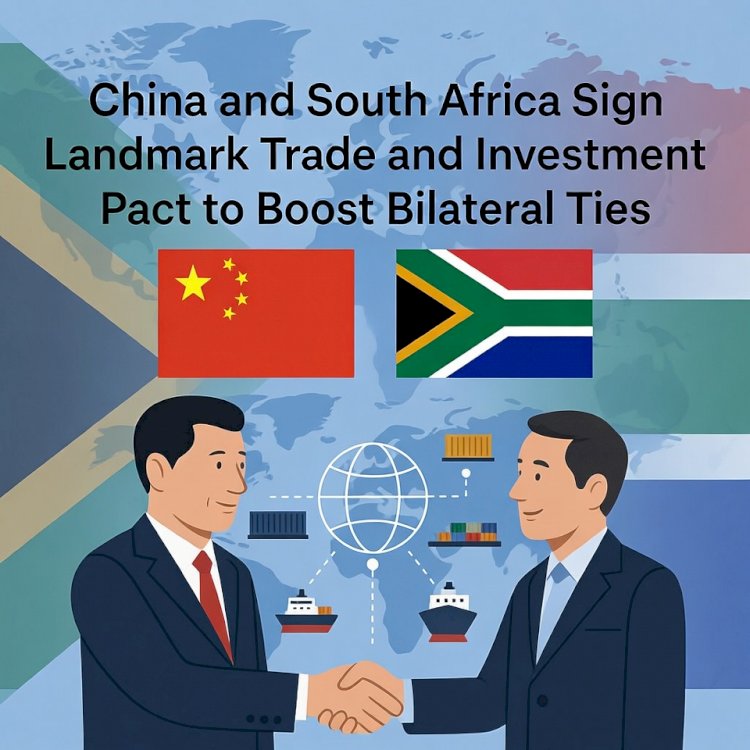
China and South Africa Sign Landmark Trade and Investment Pact to Boost Bilateral Ties
 content-team
February 07, 2026
China and South Africa finalized a major comprehensive trade and investment agreement in Pretoria on Saturday, significantly expanding market access, reducing tariffs on key commodities, and deepening cooperation in critical minerals, green technology, and infrastructure development. The deal, signed by Chinese Vice Premier He Lifeng and South African Minister of Trade, Industry and Competition Parks Tau, marks one of the most substantial bilateral economic pacts between the two BRICS partners in recent years.
President Cyril Ramaphosa hailed the agreement as "a game-changer for South African industrialization and job creation," while Chinese officials described it as a concrete step toward building a high-level community of shared future between the two nations.
Key Provisions of the Agreement
The pact includes the following major components:
- Immediate elimination or substantial reduction of tariffs on over 80 percent of South African exports to China, with particular focus on agricultural products (citrus, wine, beef, wool, macadamia nuts), minerals (platinum group metals, manganese, chrome ore), and manufactured goods.
- China commits to increasing imports of South African critical minerals essential for battery production and renewable energy technologies, with long-term supply agreements valued at more than $15 billion over the next five years.
- Reciprocal tariff cuts on Chinese machinery, electronics, solar panels, electric vehicles, and telecommunications equipment entering South Africa.
- Establishment of a $10 billion joint investment fund targeting renewable energy projects, electric vehicle manufacturing, green hydrogen production, and digital infrastructure in South Africa.
- Enhanced cooperation in standards alignment, intellectual property protection, and dispute resolution mechanisms to facilitate smoother trade flows.
- Special provisions for small and medium enterprises, including simplified customs procedures and technical assistance programs.
Officials project the agreement will increase bilateral trade volume by at least 25 percent within three years, building on the already robust $54 billion in two-way commerce recorded in 2025.
Strategic and Political Context
The signing follows months of intensive negotiations accelerated after the BRICS summit in Kazan last October, where both leaders expressed commitment to strengthening South-South economic ties amid global trade uncertainties. South Africa, as the continent's most industrialized economy and China's largest African trading partner, gains significantly from improved access to the world's second-largest consumer market.
For China, the deal secures reliable long-term supplies of strategic minerals while reinforcing its position as Africa's top economic partner. It also aligns with Beijing's Global Development Initiative and efforts to diversify supply chains away from Western-dominated sources.
The agreement comes at a time when South Africa faces domestic pressure to balance its relations with traditional Western partners and its growing alignment with BRICS nations. Ramaphosa emphasized that the pact complements rather than competes with existing trade frameworks, including the African Continental Free Trade Area (AfCFTA) and South Africa's preferential access to the European Union and United States markets.
Market and Industry Response
South African agricultural exporters, mining companies, and renewable energy firms welcomed the tariff reductions as a major boost to competitiveness in the Chinese market. Shares in relevant sectors rose sharply on the Johannesburg Stock Exchange Monday morning.
Chinese companies involved in infrastructure, mining, and green technology expressed optimism about accelerated project pipelines and joint ventures. Global commodity markets saw modest upward movement in platinum group metals and manganese futures following the announcement.
The United States and European Union have not yet issued formal reactions, though analysts expect close monitoring given China's deepening footprint in African critical minerals supply chains.
Looking Ahead
Implementation working groups from both countries will convene within 60 days to finalize detailed schedules for tariff phase-outs and investment commitments. The agreement includes a review mechanism every two years to address emerging issues and expand cooperation.
As one of the most concrete outcomes of the BRICS economic cooperation agenda, the China-South Africa trade and investment pact signals deepening ties between the two emerging economies at a time of shifting global trade dynamics. For South Africa, it offers a vital lifeline for export growth and industrial development; for China, it strengthens strategic resource security and influence across the African continent.