
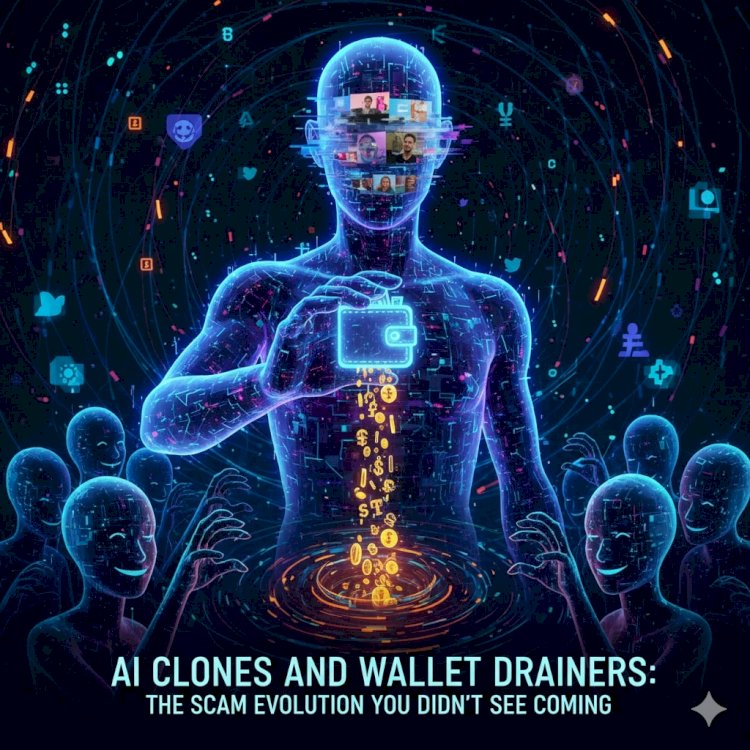
AI Clones and Wallet Drainers: The Scam Evolution You Didn’t See Coming
 content-team
By Dr. Pooyan Ghamari, Swiss Economist and Visionary
In 2022 the standard crypto scam still looked like a Nigerian prince with better graphics. By late 2025 the victim often loses his life savings while having a pleasant fifteen-minute video call with someone he trusts completely — someone who does not exist.
Welcome to the age of the personalized, AI-orchestrated wallet massacre.
Phase One: The Perfect Replica
It starts with data most people already leak for free.
Your favorite YouTuber posted 400 hours of footage. Your cousin live-streams every family dinner. Your CEO loves LinkedIn voice notes. An open-source 2025 voice-cloning model needs less than sixty seconds of clean audio to reproduce any human voice with chilling accuracy. Add a real-time video avatar trained on the same public clips and you have a clone that passes every casual Turing test.
The scammer no longer needs to trick you with typos and broken English. He arrives as your exact friend, your exact portfolio manager, your exact Vitalik Buterin.
Phase Two: The Warm-Up Call
The clone calls you on Telegram or WhatsApp (spoofed number, end-to-end encryption, zero trace).
“Hey man, quick question — did you get my DM about the new liquidity pool? We’re front-running the announcement with the same group as last time. I’m already in with 40 ETH.”
Your brain hears the voice you’ve heard a thousand times. The avatar blinks at exactly the right rhythm. The background is the same cluttered bookshelf he always has. You feel the gentle pressure of not wanting to miss out, mixed with the warmth of being included in the inner circle.
You never notice that the clone never lets you speak for more than four seconds before gently interrupting — because long silences would expose the 400-millisecond latency gap.
Phase Three: The Drain
The clone walks you through “syncing” your wallet for the “shared staking dashboard.” He shares his screen (another AI-generated desktop that looks identical to his usual setup). You are asked to approve what appears to be a harmless signature request.
It is, of course, a SetApprovalForAll to a freshly deployed contract that now owns every NFT and token in your wallet.
Average time from first ring to empty wallet: eleven minutes.
Average victim reaction when he replays the call recording later: “But I watched him do it with me.”
The Numbers Are Already Terrifying
In Q3 2025 alone, Chainalysis quietly tracked a new category they label “deepfake-assisted theft” totaling just under $1.4 billion — more than all ransomware proceeds combined for the same period. Most victims never report, because the shame of being tricked by “your best friend” is worse than the financial loss.
And we are still in the clumsy beta phase using 2024-level tools.
The 2026 Upgrade Nobody Wants to Imagine
Next year the same pipeline becomes:
- Real-time ray-traced avatars indistinguishable from broadcast television
- Voice clones that sing, cry, and get drunk convincingly
- Persistent memory of every past conversation you ever had with the real person (scraped from your own leaked Telegram archives)
- Fully automated farms running thousands of parallel “relationships” 24/7
At that point scams stop being individual crimes and become industrial processes with customer-support shifts and performance KPIs.
The Defense That Doesn’t Work
- “I’ll just never click strange links.” The victim clicks nothing. He types the “official” dashboard URL shown on the trusted clone’s screen.
- “I’ll use hardware wallet confirmations.” You will personally press “approve” while looking into the eyes of your mother’s perfect clone begging you to help with medical bills.
- “I’ll set up a passphrase only my friends know.” The clone already knows it — he read your private Twitter circle posts using a compromised account you forgot existed.
The Only Two Defenses That Might Survive
- Lifeline phrases — pre-agreed nonsense words (“pineapple helicopter”) that real friends must slip into any urgent money discussion. Crude, but currently unbreakable by AI.
- Zero-trust wallet architecture — devices that physically refuse to sign SetApprovalForAll or unlimited spend allowances under any circumstances, no matter how trusted the face on the screen. (Almost no retail wallets still allow it in 2025.)
Everything else is theater.
Final Warning from Zug
The era of the lazy phishing DM is over. The new era is intimate, emotional, and ruthlessly personalized.
Your next scam call will not come from a stranger. It will come from you — speaking to yourself — perfectly.