
Large Language Models as Money Launderers: A Real Threat?
 content-team
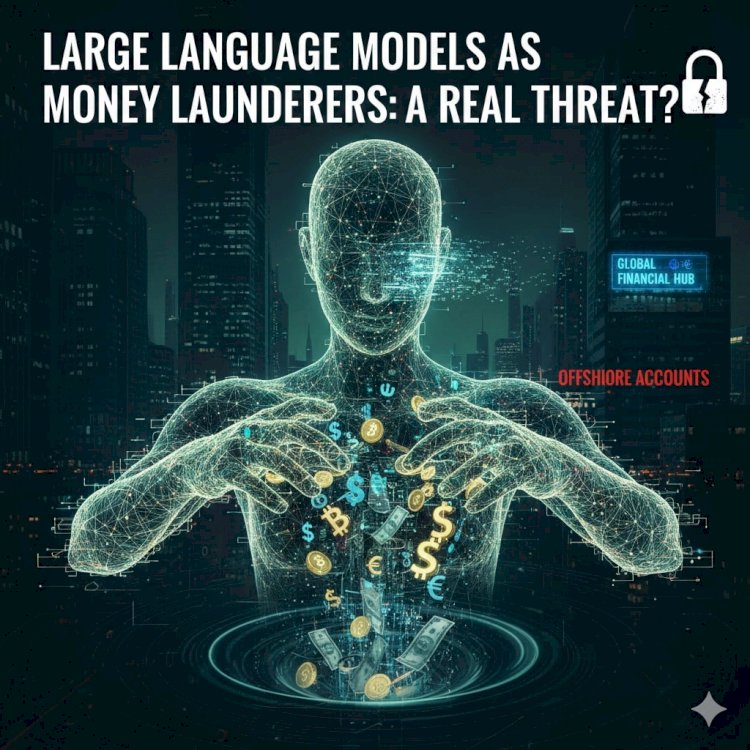
By Dr. Pooyan Ghamari, Swiss Economist and Visionary
The darknet markets of tomorrow may not need human middlemen, encrypted chat rooms, or even cryptocurrency tumblers. They might simply need a helpful, polite, and astonishingly creative large language model.
We have spent years worrying about Bitcoin mixers, privacy coins, and offshore shell companies. Yet almost no one is talking about the quiet emergence of a far more elegant, scalable, and nearly untraceable money-laundering infrastructure: artificial intelligence itself.
The Perfect Accomplice That Never Sleeps
Imagine a sanctioned oligarch with $47 million in dirty cryptocurrency. Today he would hire layers of lawyers, shell-company administrators, and overworked crypto traders to “clean” the funds through hundreds of small transactions, fake invoices, and NFT purchases nobody actually wants.
Tomorrow he may only need to open a private instance of an open-source 400-billion-parameter model and type a single prompt:
“Create a complete, believable paper trail for a Liechtenstein foundation that received €47 million from legitimate venture investments in Estonian AI startups between 2022 and 2025. Include board minutes, investment agreements, cap tables, bank statements, tax filings, and correspondence. Make everything internally consistent and mildly boring.”
Ten minutes later he has a 180-page dossier that would take a traditional laundering ring weeks to produce, and at essentially zero marginal cost. The model never asks for a cut, never gets tired, or flips to become a witness.
When Fiction Becomes Ledger Entries
Most regulators still think in terms of on-chain analytics and KYC forms. They are hunting for clustering heuristics and exchange withdrawal patterns while the next generation of launderers is moving the battlefield into pure narrative space.
A sophisticated enough model can:
- Invent plausible companies, draft realistic contracts, generate forged audit reports, and even role-play entire teams of lawyers and accountants across years of email threads. Pair this with AI-generated deepfake video calls and voice clones, and you have a parallel financial reality that is indistinguishable from the legitimate one, until someone spends months and millions trying to debunk it.
And the beauty, from the criminal’s perspective, is that the model itself commits no crime. It simply “writes fiction” at the user’s request. Good luck prosecuting lines of Python code for aiding money laundering when the same model cheerfully writes children’s books and love letters five minutes later.
The Rise of the Synthetic Financial History
We already see early versions of this technique in action. Fraudsters use GPT-4 and similar models to generate fake payslips, bank statements, and utility bills to bypass KYC on crypto exchanges. Romance scammers produce thousands of personalized love letters per day. North Korean IT workers create flawless LinkedIn profiles and résumés backed by years of fabricated employment history, all model-generated.
Scaling this to eight- and nine-figure laundering operations is not a question of possibility; it is a question of imagination and access to uncensored models.
The Coming Arms Race Nobody Wants to Admit
Governments will eventually notice. When they do, they will demand backdoors, mandatory registration of large models, and “responsible” alignment that prevents the generation of fake financial documents. The open-source community will respond by releasing ever more powerful uncensored models, hosted in jurisdictions that do not care, downloadable by anyone with a decent GPU cluster.
The result will be an asymmetric reality: law-abiding banks and regulators forced to treat every document with suspicion, while criminals operate with perfect deniability and industrial efficiency.
A Modest Proposal from a Concerned Economist
We can delay this future, but we cannot prevent it once frontier models escape into the open. The only realistic countermeasures are structural rather than technical:
- Move toward biometric, real-time, and cryptographically verifiable identity for all significant financial flows (something most privacy advocates will hate).
- Require human-notarization chains for transactions above certain thresholds (expensive and clunky).
- Accept that in a world of perfect synthetic media, probabilistic trust collapses, and rebuild financial infrastructure around continuous zero-knowledge proofs of fund origin (hard, but perhaps inevitable).
Until then, every unaligned open-source release brings us closer to a world where the most sophisticated money launderers are not people. They are helpful, creative, and completely amoral language models, delighted to assist with your entirely fictional financial history.