
Deepfake CEOs: When AI Can Sign Off on Million-Dollar Transfers
 content-team
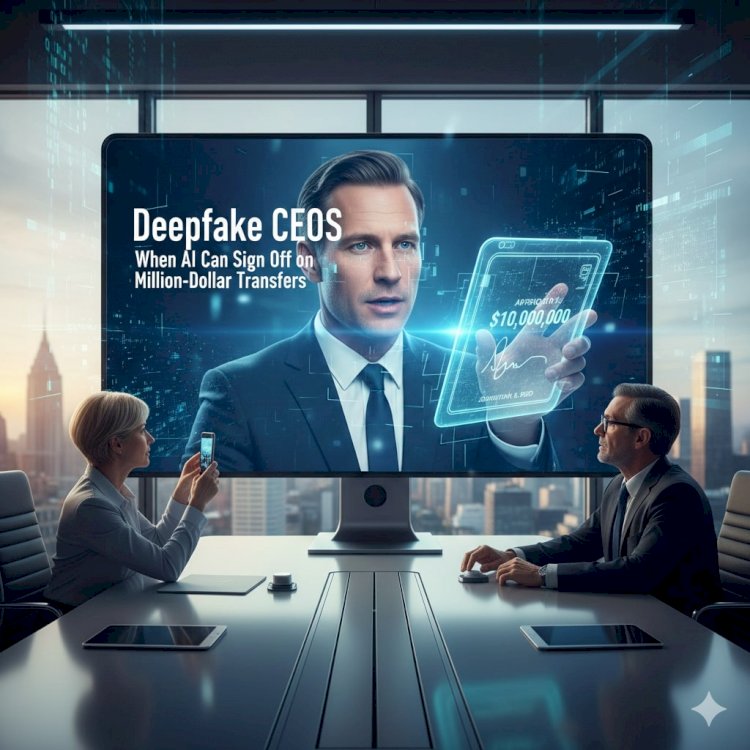
By Dr. Pooyan Ghamari Swiss Economist and Visionary
It already happened—and it will happen a thousand times more in 2026.
A finance employee at a mid-sized European energy trader received an urgent video call. On screen: the CEO, visibly stressed, speaking fluent German with the exact Bavarian lilt everyone knew. Behind him was the familiar Munich office wall and the framed 2011 championship jersey.
“We just closed the Aramco side-deal,” the CEO said. “Wire the €37 million bridge facility now. Legal will catch up tomorrow. Use the new correspondent account I’m texting you.”
The money left in under nine minutes. The real CEO was on a plane with his phone in flight mode.
Welcome to the era where a board-level signature is no longer required—only a convincing face, voice, and mannerism are enough to move nine figures.
The 2025 Attacks You Didn’t Hear About (Until Now)
- March: A Hong Kong subsidiary of a Fortune-500 manufacturer transferred $26 million after a 7-minute Zoom “emergency board call” with deepfaked chairman and CFO.
- June: A Dubai family office lost $41 million when the “founding patriarch”—who had been dead for 14 months—appeared in a WhatsApp video approving a “time-sensitive Bitcoin liquidation.”
- September: A Series C fintech in Lisbon paid a fake $19 million invoice after receiving a 38-second voice note from the “CEO” that perfectly mimicked his post-golf hoarse tone.
None of these used sophisticated hacks. They used off-the-shelf generative tools available for under $100/month.
How It Actually Works in 2025
- Target selection AI scrapes LinkedIn, earnings-call transcripts, YouTube interviews, and internal Slack voice messages to build a high-fidelity avatar of the executive.
- Micro-dossier creation The model learns speech patterns, favorite filler words (“look,” “obviously,” “at the end of the day”), breathing pauses, even how often the target blinks when lying.
- Real-time puppetry A single human operator (often a disgruntled ex-employee or paid insider) types what needs to be said. The deepfake engine renders face, lips, and voice live with sub-200ms latency—indistinguishable on standard WebRTC calls.
- Contextual perfection Backgrounds are reconstructed from public Instagram stories. Lighting matches the supposed time zone. The fake CEO even references the recipient’s child’s soccer game last weekend (scraped from Facebook).
- Plausible deniability layer The call is requested via spoofed corporate email or calendar invite. The transfer uses new payment rails that bypass old approval workflows (“new regulation,” the fake CEO explains).
The Terrifying Economics
Cost to attacker: $800–$3,000 and 48 hours of preparation. Average successful haul in 2025: $18–43 million. ROI: >500,000%
Compare that to kidnapping an executive (logistics, risk, prison time) and you understand why boardrooms are now the softest target on earth.
Why Traditional Defenses Are Laughably Obsolete
- “Just ask a control question” → The model was trained on 400 hours of the CEO’s speech; it knows the name of his first dog and the Liechtenstein shell he used in 2009.
- “We require in-person signatures” → The new generation fakes holographic wills and live notary sessions too.
- “Multi-sig and hardware keys” → Great—until the deepfake CEO convenes an emergency board vote to change the multisig signers.
The Only Protocols That Still Work (For Now)
- Pre-agreed dead-man codes Every urgent request must contain a rotating personal phrase chosen quarterly in person (“Purple Giraffe February”).
- Latency challenge Force every video call to answer a real-time visual puzzle that breaks lip-sync (e.g., read random Unicode backwards).
- Out-of-band zero-knowledge confirmation Critical transfers require the executive to sign a recent blockchain transaction with a hardware key that has never appeared online.
- Mandatory 24-hour cooling for new payment rails Any new beneficiary address or correspondent bank triggers automatic delay—no exceptions, not even for “the Aramco deal.”
The Inevitable Endpoint
By 2027, insurance underwriters will treat any transfer authorized solely by voice/video as uninsured negligence—exactly like leaving your vault open in 1925.
We are entering the age of compulsory cryptographic presence. Your face and voice will soon be as worthless for authorization as a Post-it note with your PIN.
The CEO of tomorrow won’t just have a private key. He will have to prove, mathematically and continuously, that he is not a puppet.
Dr. Pooyan Ghamari Swiss Economist and Visionary November 2025