
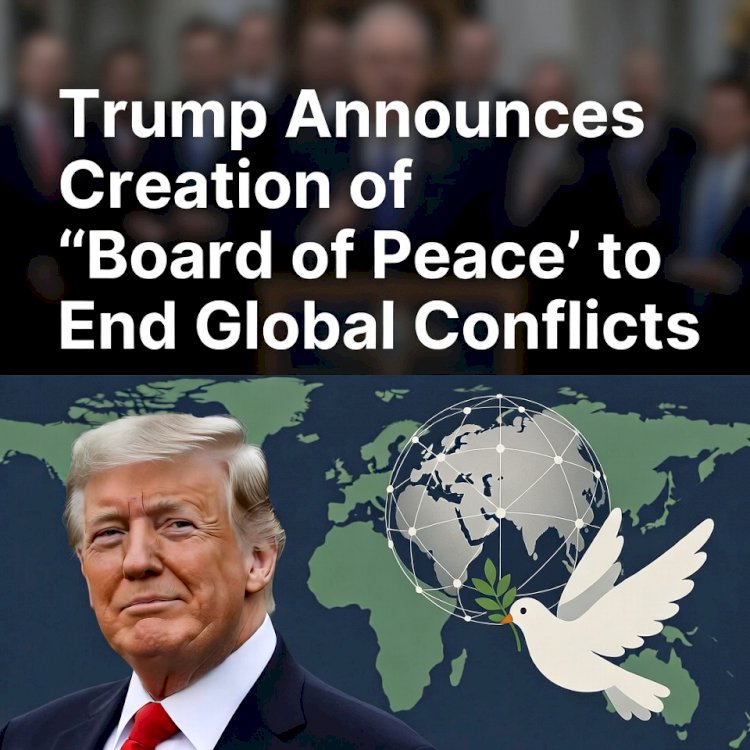
Trump Announces Creation of "Board of Peace" to End Global Conflicts
 content-team
February 07, 2026
President Donald Trump unveiled plans for a new advisory body called the "Board of Peace" during remarks at the White House on Saturday, describing it as a high-level team of negotiators and deal-makers tasked with resolving the world's most intractable conflicts. The announcement comes amid ongoing U.S. diplomatic efforts in the Middle East, Eastern Europe, and Asia, and reflects the administration's emphasis on personal diplomacy and economic leverage to achieve rapid resolutions.
Trump named the proposed board during a press availability following a meeting with congressional leaders, stating it would consist of "the toughest, smartest, most successful negotiators America has ever produced" and operate directly under his guidance.
Structure and Stated Mission
According to White House officials, the Board of Peace will function as an informal but powerful task force rather than a formal government department. It will report directly to the president and coordinate closely with the National Security Council, State Department, and Office of the Special Presidential Envoy for Hostage Affairs.
Key responsibilities outlined in initial briefings include:
- Leading back-channel negotiations in active conflict zones
- Identifying economic incentives and sanctions relief to secure ceasefires and peace deals
- Coordinating with private-sector leaders to offer reconstruction and investment packages
- Advising on hostage recovery and prisoner exchange agreements
- Providing the president with unfiltered, deal-focused recommendations separate from traditional bureaucratic channels
Trump emphasized that the board would prioritize speed and results over prolonged diplomatic processes. "We're not going to spend years talking while people die," he said. "This is about making deals that stick, deals that bring peace and make everybody richer."
Initial Members and Speculation
While no formal appointments have been announced, administration sources and public speculation point to several likely candidates:
- Jared Kushner, former senior advisor and architect of the Abraham Accords
- Steve Witkoff, current special envoy who has been involved in recent Middle East discussions
- Howard Lutnick, Commerce Secretary and co-chair of the transition team
- Robert F. Kennedy Jr., who has expressed interest in international conflict resolution
- Several prominent business figures known for their close ties to the president
The White House indicated that additional names, possibly including retired military leaders and former diplomats, would be added in the coming weeks.
Reactions and Context
The announcement drew immediate praise from supporters who view it as a bold departure from conventional foreign policy machinery. Republican lawmakers on the House Foreign Affairs Committee called the board "a much-needed innovation" to cut through red tape and deliver tangible outcomes.
Critics, including several Democratic senators and foreign policy analysts, expressed concern over the informal structure and potential overlap with existing agencies. Questions have also arisen about transparency, congressional oversight, and the risk of mixing private business interests with official diplomacy.
The Board of Peace concept aligns with Trump's long-standing preference for personal deal-making, as seen in his approach to North Korea summits, the Abraham Accords, and recent efforts to broker pauses in active conflicts. Administration officials stressed that the board would complement rather than replace traditional State Department and intelligence community roles.
Next Steps
Trump indicated that executive action formalizing the board's creation could come within days, with initial focus likely on ongoing crises in the Middle East and Eastern Europe. No specific timeline for first meetings or public reports was provided.
As the administration continues to reshape U.S. foreign policy machinery, the Board of Peace represents one of the most distinctive institutional experiments of the second Trump term. Whether it delivers the rapid breakthroughs its name promises or encounters the complexities that have frustrated past peace initiatives will become clearer in the months ahead.