
Thailand and Cambodia Sign Ceasefire: End to Weeks of Deadly Border Clashes
 content-team
December 27, 2025
In a significant step toward de-escalation, Thailand and Cambodia have signed a new ceasefire agreement to halt weeks of intense fighting along their disputed border, bringing relief to hundreds of thousands displaced by the violence that has claimed over 100 lives.
Immediate Truce Takes Effect Amid Fragile Hope
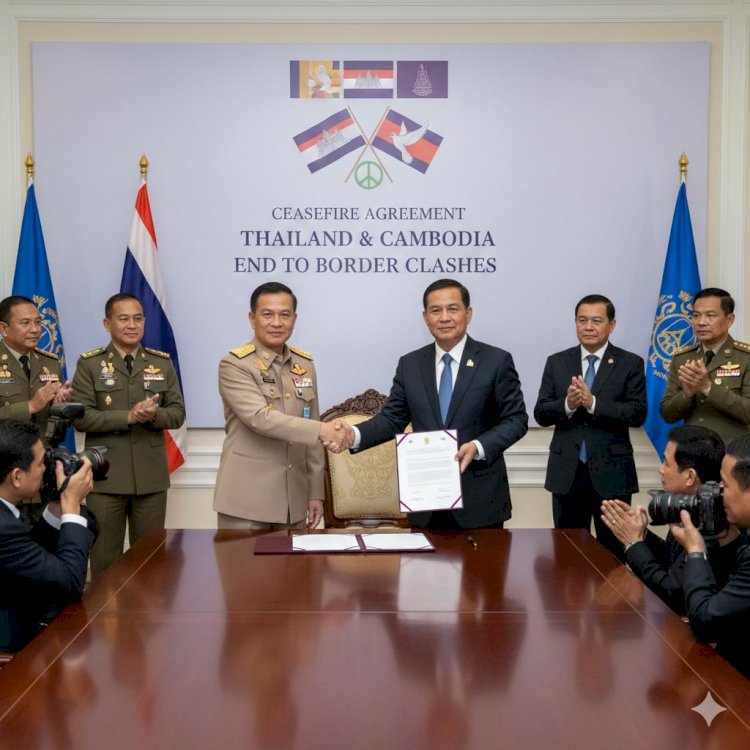
The accord was finalized on Saturday at a border checkpoint in Thailand's Chanthaburi province, where Defense Minister Natthaphon Narkphanit and his Cambodian counterpart Tea Seiha exchanged documents following three days of military-level talks. The ceasefire commenced at noon local time (05:00 GMT), covering all weapons, attacks on civilians, and military objectives.
Key provisions include:
- No further troop movements or reinforcements.
- Prohibition on airspace violations for military purposes.
- Repatriation of 18 Cambodian soldiers captured by Thailand since July clashes, contingent on the truce holding for 72 hours.
- Cooperation on demining, combating cybercrime, and refraining from disseminating false information.
- Safe return of displaced civilians without force against them.
The deal will be monitored by an ASEAN observer team alongside direct bilateral coordination, underscoring regional involvement in maintaining peace.
Roots of the Conflict: A Century-Old Border Rift
The fighting stems from longstanding territorial disputes along the 817-kilometer (508-mile) frontier, exacerbated by competing claims over ancient temples and undemarcated areas. Tensions trace back to colonial-era maps, with flare-ups around sites like Preah Vihear Temple, ruled Cambodian by the International Court of Justice in 1962 and 2013.
The latest escalation began in late July with intense clashes, leading to a fragile truce brokered by Malaysia and backed by U.S. President Donald Trump, dubbed the "Kuala Lumpur Peace Accords." That agreement collapsed in early December, reigniting hostilities with airstrikes (exclusively by Thailand), rocket exchanges, and artillery barrages. The violence displaced over half a million people—nearly a million cumulatively since summer, and spread from forested northern zones near Laos to southern coastal provinces on the Gulf of Thailand.
Recent airstrikes, including one early Saturday before the signing, underscored the urgency of the breakthrough, facilitated by ASEAN diplomacy and encouragement from China and the U.S. State Department.
Relief and Skepticism on the Ground
Civilians on both sides expressed cautious optimism. In Cambodia's Poipet near the border, reporter accounts noted the guns falling silent post-truce, though sporadic firing persisted until the deadline. Thai officials emphasized the 72-hour window as a test of Cambodia's commitment, warning against provocations.
The agreement revives commitments from prior deals but adds specifics on landmines, a Thai concern amid reports of injuries from alleged Cambodian placements—and civilian protections.
Broader Implications for Southeast Asia
This second ceasefire in months highlights the volatility of unresolved border issues but also the effectiveness of multilateral pressure from ASEAN, with Malaysia's Anwar Ibrahim playing a key mediating role. It avoids deeper internationalization while paving the way for ongoing demarcation talks through existing mechanisms.
As displaced families eye returns and markets stabilize, the truce offers a glimmer of stability in a region prone to flare-ups. Yet, with historical grievances unresolved, observers warn that sustained dialogue is essential to prevent another breakdown.
In the wake of this hard-won pause, Thailand and Cambodia now face the challenge of rebuilding trust amid the rubble of their shared frontier.