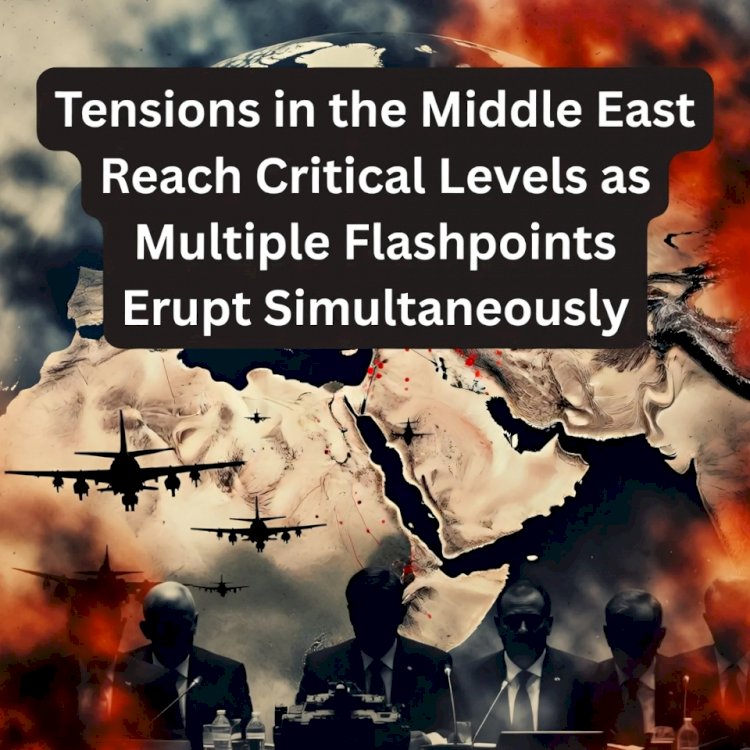
Tensions in the Middle East Reach Critical Levels as Multiple Flashpoints Erupt Simultaneously
 content-team
February 19, 2026
The Middle East stands on the brink of wider regional conflict today as a cascade of military incidents, diplomatic breakdowns and proxy escalations unfolded across several fronts in less than 24 hours. Analysts warn that the convergence of crises in Gaza, southern Lebanon, the Red Sea, Syria and the Persian Gulf has created the most dangerous security environment in the region since the 1973 Yom Kippur War.
In Gaza, Israeli forces launched pre-dawn airstrikes on multiple Hamas command centers in Khan Younis and Rafah after detecting what the IDF described as "imminent attack preparations." Palestinian health officials reported 47 killed and over 200 wounded, mostly civilians, in the heaviest bombardment since the November 2025 ceasefire. Hamas military spokesman Abu Obaida vowed "a response that will shake the entity," while Israeli Defense Minister Yoav Gallant stated the strikes were "preventive and limited" but warned that "any rocket fire will be met with overwhelming force."
Simultaneously, Hezbollah fired more than 40 rockets from southern Lebanon into northern Israel, targeting military sites near Kiryat Shmona and Safed. The barrage wounded 12 Israeli soldiers and civilians and triggered air-raid sirens across the Galilee. The IDF responded with artillery and drone strikes on Hezbollah positions north of the Litani River, the first significant cross-border exchange since the January partial disarmament agreement began.
In the Red Sea, the U.S. Navy destroyer USS Carney engaged and destroyed three Houthi anti-ship ballistic missiles launched from Yemen toward commercial shipping lanes. The Pentagon confirmed the missiles were aimed at a U.S.-flagged container vessel carrying military cargo to Israel. Houthi military spokesman Yahya Saree claimed responsibility and threatened "expanded operations" if U.S. and British warships continued "piracy" in the Bab al-Mandab Strait.
Syria saw fresh violence as Turkish-backed Syrian National Army forces clashed with Kurdish-led SDF units near Manbij, killing at least 19 fighters on both sides. The incident followed reports of Iranian-backed militias moving reinforcements toward Deir ez-Zor, raising fears of renewed Shia-Sunni proxy fighting in eastern Syria.
Diplomatic efforts to contain the spiraling tensions have stalled. U.S. Secretary of State Marco Rubio cancelled a planned meeting with Saudi Crown Prince Mohammed bin Salman after Riyadh publicly criticized the U.S. for "failing to restrain Israel" in Gaza. Iran’s Foreign Minister Abbas Araghchi accused the U.S. of "creating a new front" in the region through its naval presence in the Gulf and threatened "severe consequences" if American forces strike Iranian assets or proxies.
Oil prices surged 4.2% in early trading today, with Brent crude briefly topping $89 per barrel before settling around $87.80. Shipping insurance rates for vessels transiting the Red Sea and Strait of Hormuz have risen 35% in the past 48 hours.
UN Secretary-General António Guterres called an emergency Security Council session for tomorrow and urged all parties to exercise "maximum restraint." European Union foreign policy chief Kaja Kallas warned that "the region is one miscalculation away from a multi-front war."
With multiple active fronts, fragile ceasefires collapsing, and major powers increasingly involved through proxies, the Middle East is experiencing its most volatile moment in years. Diplomats and analysts agree: the next 72 hours will be decisive in determining whether the current escalation can be contained or spirals into a broader regional conflict. Live updates continue from major international broadcasters and the UN press room.