
Michelle Bachelet Emerges as Leading Contender to Become First Female UN Secretary-General
 content-team
February 02, 2026
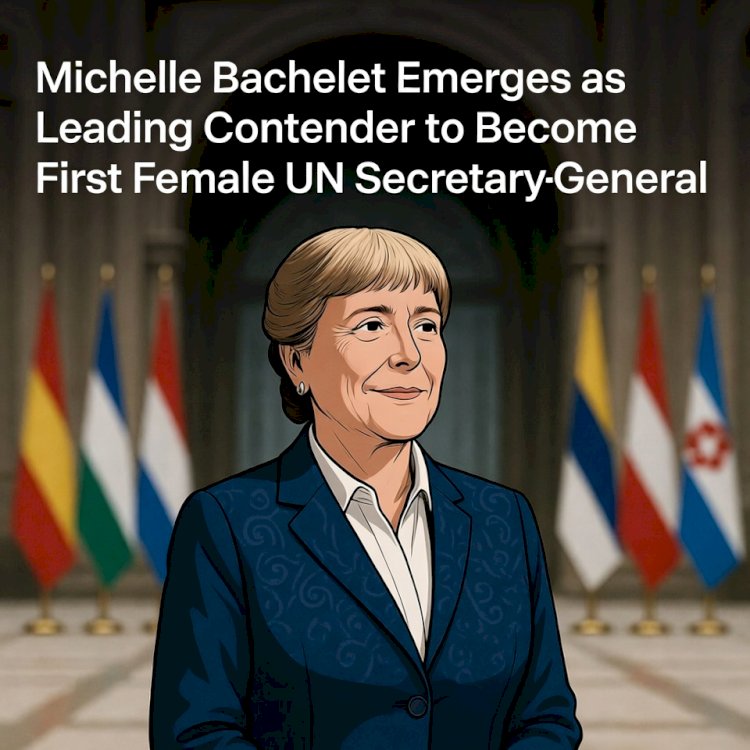
Former Chilean President Michelle Bachelet has solidified her position as a frontrunner in the race to succeed António Guterres as United Nations Secretary-General, following Chile's official nomination of her candidacy with explicit support from Mexico and Brazil. The move positions Bachelet as the most prominent female candidate so far in the 2026 selection process, fueling widespread hope that the UN could finally appoint its first woman leader after eighty years of male tenure.
Bachelet's formal entry, announced February 2 by outgoing President Gabriel Boric, marks a significant step in a selection cycle that has seen growing calls for gender parity at the organization's highest level. Guterres, whose second term ends December 31, 2026, has himself stated it is "clearly time for a woman" to lead the UN.
Bachelet's Extensive Credentials Bolster Bid
Bachelet, 74, brings unparalleled experience to the race. She served two terms as President of Chile (2006-2010 and 2014-2018), becoming the country's first female head of state. Within the UN system, she held the post of High Commissioner for Human Rights (2018-2022) and Executive Secretary of the Economic Commission for Latin America and the Caribbean. Her background spans diplomacy, human rights advocacy, and executive leadership across global challenges including inequality, climate action, and multilateral cooperation.
The nomination carries regional weight from the Latin American and Caribbean Group, which has not produced a Secretary-General since Javier Pérez de Cuéllar of Peru (1982-1991). Boric described the candidacy as a shared regional hope to amplify voices from the Global South in addressing collective crises.
Momentum Builds for Historic First
The push for a female Secretary-General has intensified since the joint letter from the presidents of the General Assembly and Security Council in November 2025 explicitly encouraged member states to nominate women. At least 94 countries have expressed support for gender balance in statements tracked by advocacy groups, with civil society campaigns like 1 for 8 Billion urging exclusive female nominations.
Other female contenders include Rebeca Grynspan of Costa Rica (Secretary-General of UNCTAD), Alicia Bárcena of Mexico (current Environment Minister with prior senior UN roles), and María Fernanda Espinosa of Ecuador (former UN General Assembly President). Speculation also surrounds figures like Barbados Prime Minister Mia Mottley and UN Deputy Secretary-General Amina Mohammed of Nigeria.
Only one male candidate, Rafael Grossi of Argentina (Director General of the International Atomic Energy Agency), has received an official nomination to date.
Selection Process Underway with Transparency Focus
The process, expected to conclude in late 2026 with the new Secretary-General taking office January 1, 2027, involves member states submitting nominations followed by closed-door deliberations in the Security Council. The Council recommends one candidate to the General Assembly for final approval, where the P5 permanent members hold veto power.
Advocates emphasize the need for greater transparency, including public candidate dialogues (scheduled to begin in April 2026) and consideration of geographic rotation alongside gender equity. While Latin America appears favored regionally, the veto dynamics and geopolitical realities will ultimately decide the outcome.
Historic Opportunity Amid Global Challenges
With the UN facing credibility strains from geopolitical divisions, climate crises, and multilateralism debates, supporters argue a female leader could bring fresh perspectives on coalition-building, empathy in conflict resolution, and renewed focus on human rights and sustainable development.
Bachelet's candidacy has already galvanized regional backing and international attention, positioning her as the woman most likely to break the glass ceiling. Whether she overcomes Security Council hurdles remains uncertain, but the momentum signals 2026 could finally deliver the UN's first Madam Secretary-General. The coming months of nominations, dialogues, and negotiations will determine if history is made.