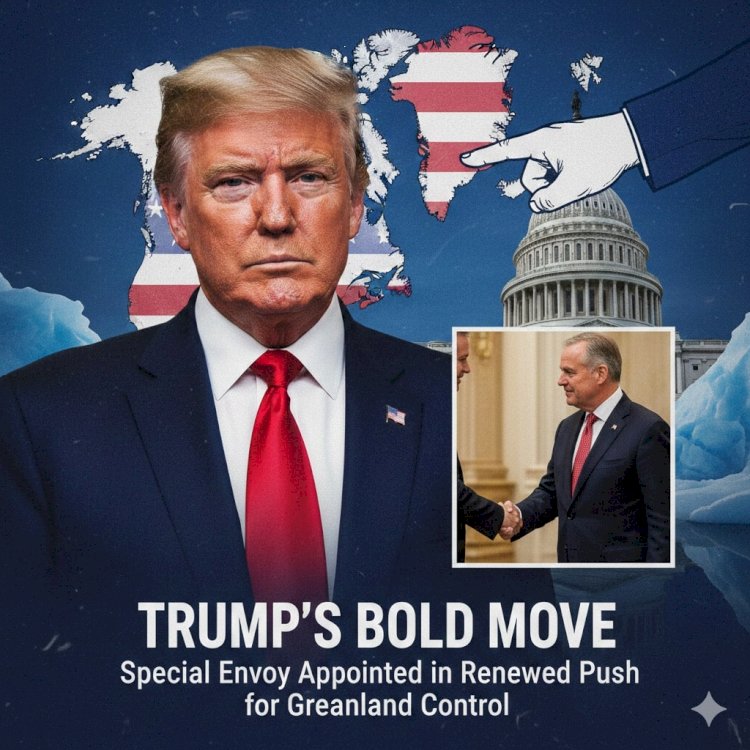
Trump's Bold Move: Special Envoy Appointed in Renewed Push for Greenland Control
 content-team
December 23, 2025
Tensions between the United States, Denmark, and Greenland escalated dramatically as President Donald Trump doubled down on his long-standing ambition to bring the vast Arctic island under American influence, appointing a special envoy tasked with advancing U.S. interests there.
Envoy Appointment Ignites Diplomatic Firestorm
On Sunday, Trump named Louisiana Governor Jeff Landry as the U.S. special envoy to Greenland, praising him for understanding the island's critical role in national security. Landry quickly embraced the role, declaring it an honor to work toward making Greenland "a part of the US."
The move prompted immediate backlash. Danish Prime Minister Mette Frederiksen and Greenland's Prime Minister Jens-Frederik Nielsen issued a joint statement rejecting any notion of annexation, emphasizing that "you cannot annex another country—not even with an argument about international security."
Denmark's Foreign Minister Lars Løkke Rasmussen described Landry's comments as "totally unacceptable" and announced plans to summon the U.S. ambassador in Copenhagen for an explanation.
Trump's Insistence: "We Have to Have It"
Speaking to reporters on Monday, Trump reiterated his position, stating that the U.S. needs Greenland primarily for national security reasons, citing the presence of Russian and Chinese vessels along its coasts. "We have to have it," he declared, adding that Landry would "lead the charge."
While downplaying interest in Greenland's abundant minerals, Trump highlighted strategic imperatives, including the island's position along key missile routes and its hosting of the Pituffik Space Base, a vital U.S. military installation.
Greenland and Denmark Stand Firm on Sovereignty
Greenland's leader, Jens-Frederik Nielsen, downplayed the appointment's immediate impact, noting that it "does not change anything for us at home." He reaffirmed that "Greenland belongs to the Greenlanders" and that the island's people would decide their own future.
The joint statement from Frederiksen and Nielsen underscored fundamental principles of international law: "National borders and the sovereignty of states... You cannot annex other countries." They called for respect toward the Kingdom of Denmark's territorial integrity.
European leaders expressed solidarity, with EU officials affirming support for Denmark and stressing the inviolability of sovereignty.
Broader Context: Arctic Stakes and NATO Strain
Greenland, an autonomous territory within the Kingdom of Denmark with a population of around 57,000, has grown in geopolitical importance amid melting Arctic ice, opening new shipping routes and access to rare earth minerals essential for technology and defense.
While many Greenlanders aspire to eventual independence from Denmark, polls indicate overwhelming opposition to becoming part of the United States.
The appointment marks a escalation in Trump's pursuit, which dates back years and has previously included suggestions of purchasing the island. It comes against a backdrop of strained transatlantic relations, testing ties within NATO as Denmark remains a key ally.
What's Next in the Arctic Power Play?
As diplomatic protests mount and no immediate resolution appears in sight, the controversy highlights competing visions for the Arctic's future—between U.S. security priorities, Danish sovereignty, and Greenlandic self-determination.
With no group conceding ground, this latest chapter in the Greenland saga raises profound questions about alliances, international norms, and the limits of great-power ambition in a rapidly changing polar region.
The world watches closely as the icy standoff shows signs of heating up further.