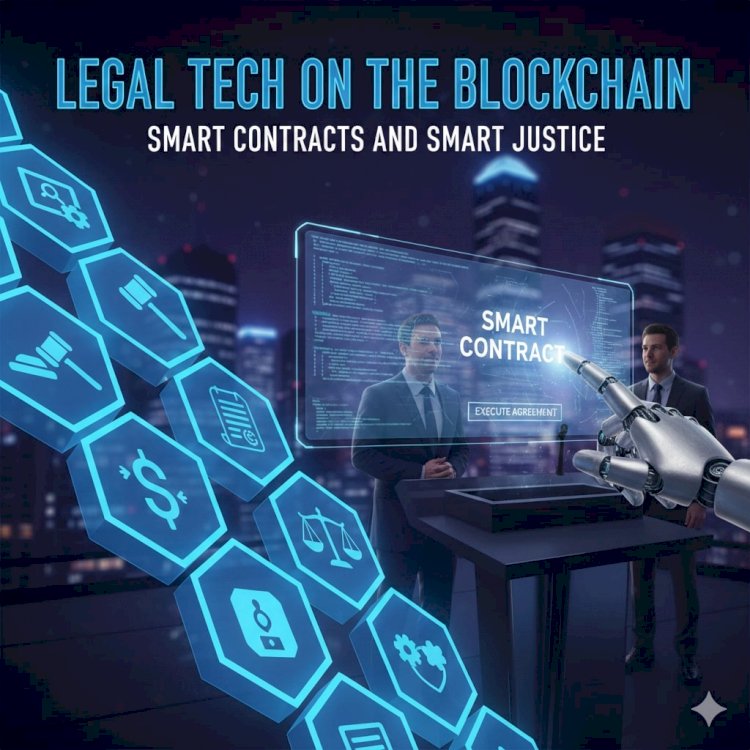
Legal Tech on the Blockchain: Smart Contracts and Smart Justice
 content-team
By Dr. Pooyan Ghamari, Swiss Economist and Visionary
The Courtroom of Tomorrow Is Already Running Code
Imagine a world where disputes are settled before they escalate, where contracts execute themselves the moment conditions are met, and where justice no longer crawls at the speed of paper and human delay. That world is not science fiction; it is being coded right now on blockchain networks. Welcome to the era of Smart Justice.
When Code Replaces the Gavel
A smart contract is not a “contract” in the traditional sense. It is self-executing law: immutable logic written into blockchain that triggers payments, transfers ownership, releases escrows, or enforces penalties automatically. No middlemen. No forgotten clauses. No “I thought it meant something else.”
If the cargo arrives late → the penalty is paid instantly. If the milestone is delivered → the freelancer is paid in seconds. If the tenant misses rent three times → the digital lock changes codes without a single court order.
This is not automation of the old system. This is replacement of the old system.
The Death of “Trust Me” and the Birth of “Verify Me”
For centuries, justice has been built on trust: trust in lawyers, trust in judges, trust in institutions. Blockchain removes the need for trust and replaces it with cryptographic proof. Every action is transparent, auditable, and irreversible (unless explicitly programmed otherwise).
The result? A dramatic drop in low-trust, high-friction disputes that clog courts today: late payments, escrow fights, simple breaches of agreement. These cases vanish because the blockchain enforces the deal before anyone has time to lawyer up.
Smart Courts: When Judges Become Referees of Code
We won’t eliminate human judges overnight (some disputes will always need wisdom, not just logic), but their role is evolving. Tomorrow’s judge will spend less time determining “what happened” (the blockchain already recorded it) and more time interpreting intent, fairness, and edge cases the code couldn’t foresee.
Picture decentralized arbitration platforms where parties pre-select jurists, stake crypto on good behavior, and receive binding rulings paid out automatically from escrow. Kleros, Aragon Court, and similar projects are not prototypes; they are already resolving real disputes in crypto-native ecosystems. Traditional courts should take note.
The Billion-Dollar Question: Are Smart Contracts Actually Legal?
Yes, and the answer is getting louder every year.
- The U.S. state of Arizona, Tennessee, and others already recognize smart contracts as legally binding.
- The EU’s MiCA regulation and the UK’s Law Commission have both stated that smart contracts can satisfy requirements of writing and signature.
- Singapore, Switzerland, and Dubai are racing to become the most blockchain-friendly jurisdictions on earth.
The law is not blocking the future; it is sprinting to catch up.
The Dark Side Nobody Wants to Talk About (But We Must)
Code is only as fair as the humans who write it. A bug in a smart contract can lock millions forever (see The DAO hack). Poorly written logic can create outcomes more unjust than any corrupt judge. And once executed, most smart contracts cannot be stopped (no “ctrl+Z” in immutable blockchains).
Smart Justice demands Smart Coders, rigorous audits, and upgradeable contract designs. The industry is learning these lessons at the cost of hundreds of millions in lost funds. The next decade will separate the amateurs from the institutions that treat legal engineering with the gravity it deserves.
The Ultimate Vision: Global Law Without Borders
Today, enforcing a contract across borders is a nightmare of jurisdictions, translations, and reciprocal agreements. Tomorrow, a properly written smart contract on a public blockchain can be enforced anywhere on Earth by anyone running a node (no embassy, no foreign court, no ten-year lawsuit).
A farmer in Kenya receives instant crop insurance payout when satellite data confirms drought. An artist in Argentina earns royalties every time her song is streamed, automatically, forever. A refugee proves identity and ownership without a single piece of paper.
This is not charity. This is frictionless global commerce and justice at lightspeed.
Final Verdict
The fusion of legal tech and blockchain is the most powerful restructuring of justice since the Magna Carta. Smart contracts are not coming; they are already here. Smart Justice is not optional; it is inevitable.
The only question left is who will write the code that governs the future: visionary builders who put fairness first, or opportunists who code for profit alone.
Choose wisely. The blockchain never forgets.
Dr. Pooyan Ghamari Swiss Economist and Visionary