When the Shadows Grow Tall
 content-team
Written by Dr. Pooyan Ghamari
Collapse is not sudden.
It comes quietly,
silently,
wearing the shoes of habit.
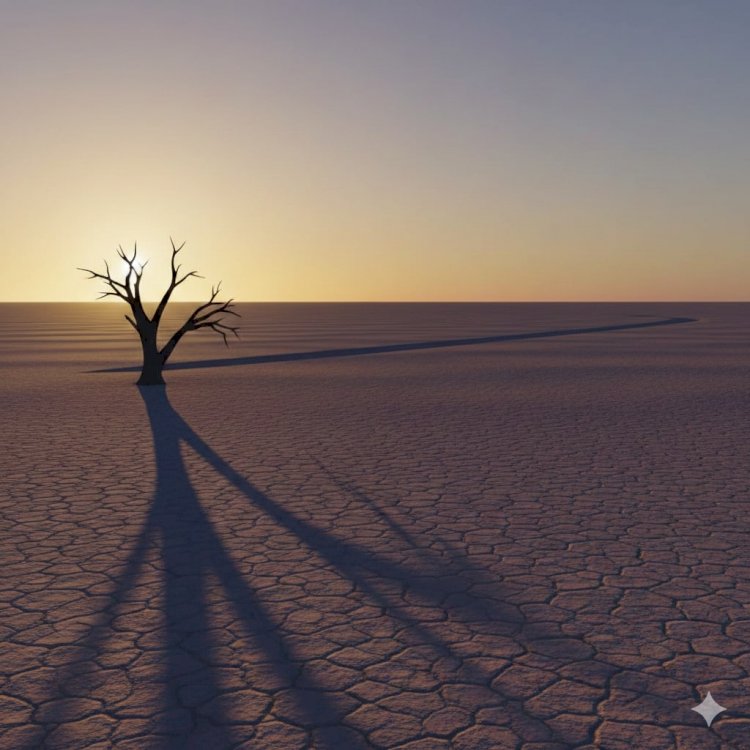
The day you notice the shadows have grown longer,
before doubting the height of people,
look at the sun.
When light diminishes,
even the shortest figures become walls.
Civilizations do not collapse by enemies,
but by forgetting;
forgetting wisdom,
forgetting questioning,
forgetting dignity.
The Geography of Inversion
In a land where
thought is idle and illiteracy is busy,
the law has language but no voice,
advisors are ill and lawyers are silent,
the young tire quickly
and the old still dream of flight,
life flows,
but meaning has migrated.
Where
men soften in order to be accepted
and women harden in order to survive,
neither man has failed
nor woman has triumphed;
humanity has stepped back.
Where
the wealthy call theft “cleverness”
and the poor, with a wage that merely keeps them from dying,
grow accustomed to “gratitude,”
ethics has been exiled from the economy.
The Qur’an: The Death of Discernment
The Qur’an does not see danger in falsehood itself;
it sees danger in mixing it with truth:
“And do not mix the truth with falsehood
or conceal the truth while you know [it].”
(Baqarah, 42)
When known truth is concealed,
society does not become blind;
worse than that,
it sees with two eyes and still loses the path.
The Torah: Human Beings Are Trustees, Not Owners
In the Torah it is said that
human beings did not come to possess,
they came to preserve:
“The Lord God placed the human in the garden
to work it and to keep it.”
(Genesis 2:15)
Wherever humans imagined themselves absolute owners,
the earth was wounded
and the future indebted.
The Gospel: Truth, the Source of Freedom
The Gospel does not consider freedom the result of power;
it considers it the result of truth:
“You will know the truth,
and the truth will set you free.”
(John 8:32)
When truth is sold to expediency,
chains become invisible
and captivity becomes respectable.
Zoroaster and the Avesta: Ethics Before Power
In the most ancient Iranian tradition,
the principle is clear:
Good thoughts, good words, good deeds
Neither power has meaning without ethics,
nor knowledge without action.
A civilization that separates these three
has already collapsed.
Buddha: The Root of Suffering
In the Dhammapada it is said:
“All things begin with the mind.
If the mind is corrupt,
suffering follows like a shadow.”
When the collective mind becomes disturbed,
no law and no wealth
can stop suffering.
Confucius: Collapse Begins at the Top
In the Confucian tradition it is said:
“If rulers are not upright,
the law becomes ineffective;
and if exemplars collapse,
the people lose their way.”
Corruption always begins at the top,
but it always spreads from the bottom.
Shams of Tabriz: Death Before Death
Shams of Tabriz warns:
“When the heart dies,
the human form remains.”
Dead-heartedness means
prayer without presence,
law without justice,
and knowledge without courage.
The dead-hearted
turn religion into a tool,
law into a ladder,
and human beings into a cost.
Socrates: The Right to Question
Socrates, before he was condemned,
set one criterion:
“An unexamined life
is not worth living.”
When questioning becomes a crime,
fabricated answers rule.
And then,
the small are seen as great
because the standards have broken.
Nietzsche: The Collapse of Measures
Nietzsche did not fear the fall of people;
he feared the fall of standards:
“That which is called virtue
is sometimes a pseudonym for weakness.”
When measures collapse,
even the righteous
lose their direction.
The Shared Compass of Humanity
This text is not a complaint;
it is a map.
The Qur’an speaks of concealing truth,
the Torah of stewardship,
the Gospel of the freedom of truth,
the Avesta of triple ethics,
Buddha of the mind,
Confucius of exemplars,
Shams of the heart,
Socrates of questioning,
and Nietzsche of standards.
All of them, in different languages,
point to one truth:
Civilization will not be saved
unless the human being is not made cheap
and truth is not made negotiable.
If the shadows have grown tall,
the sun can still be called;
not with shouting,
but by returning to wisdom,
to a living heart,
and to the courage of standing beside truth.
This voice
is not the voice of one culture;
it is the voice of humanity.