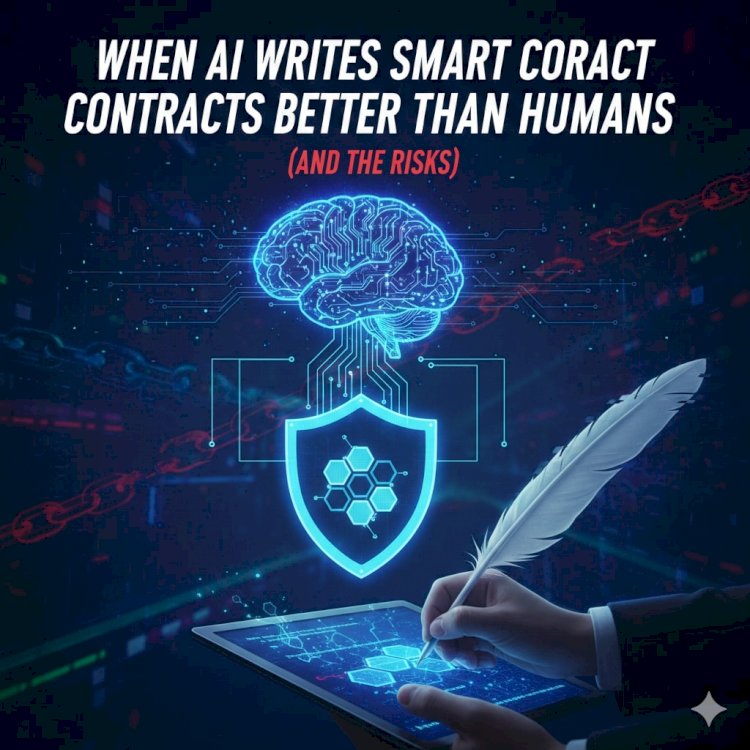
When AI Writes Smart Contracts Better Than Humans (And the Risks)
 content-team
By Dr. Pooyan Ghamari, Swiss Economist and Visionary
In the rapidly evolving world of blockchain technology, smart contracts have emerged as the backbone of decentralized finance, supply chains, and even digital governance. These self-executing pieces of code, etched immutably onto blockchains like Ethereum, promise to eliminate intermediaries, reduce costs, and enforce agreements with ironclad precision. But what happens when artificial intelligence steps in to draft them? Could AI outpace human coders in creating flawless, efficient contracts? And more importantly, what shadows lurk behind this shiny promise? Let's dive into this fascinating intersection of AI and blockchain, where innovation meets peril.
The Dawn of AI-Powered Code Wizards
Imagine a world where writing a smart contract is as simple as describing your intentions in plain English. No more late-night debugging sessions or poring over syntax errors. AI models, trained on vast repositories of code, can now generate complex smart contracts in seconds. Tools leveraging large language models (LLMs) like those from OpenAI or specialized blockchain AIs are already turning heads.
Why is AI potentially superior? Humans are prone to fatigue, oversight, and bias—factors that lead to vulnerabilities in code. AI, on the other hand, can analyze patterns from millions of successful contracts, optimizing for gas efficiency on Ethereum or security on other chains. It can simulate thousands of scenarios to stress-test the code before deployment, spotting edge cases that might elude even the sharpest developer. In essence, AI acts as an tireless virtuoso, composing symphonies of Solidity or Rust that humans could only dream of perfecting.
Take decentralized autonomous organizations (DAOs), for instance. An AI could draft governance contracts that adapt dynamically to member votes, incorporating economic models to prevent sybil attacks or token dilution. This isn't science fiction; early prototypes are already in play, promising to democratize blockchain development and lower barriers for non-coders.
Superhuman Speed: How AI Accelerates the Blockchain Revolution
Speed is the name of the game in today's hyper-competitive crypto landscape. Traditional smart contract development can take weeks, involving teams of auditors and lawyers to ensure compliance and security. AI shatters this timeline. By inputting requirements—say, a token vesting schedule with anti-whale mechanisms—an AI can output deployable code almost instantly.
This acceleration could supercharge innovation. Startups in DeFi could iterate faster, launching lending protocols or NFT marketplaces without the hefty developer salaries. For economists like myself, this means a shift in value creation: from human labor to computational intelligence. The economic implications are profound—reduced costs could funnel more capital into real-world applications, from tokenized real estate to carbon credit trading.
But it's not just about speed; it's about sophistication. AI can integrate advanced economic theories into contracts, such as game-theoretic incentives to encourage honest behavior in oracles or prediction markets. Picture a smart contract that self-adjusts interest rates based on real-time market volatility, outsmarting human-designed systems that often lag behind.
The Hidden Traps: When AI's Brilliance Turns Brittle
Yet, for all its prowess, AI isn't infallible. The risks of letting machines write our digital laws are as tantalizing as they are terrifying. First, there's the black box problem. AI models generate code based on probabilistic patterns, but they don't truly "understand" the logic. A subtle flaw in the training data—perhaps a biased dataset favoring certain blockchain protocols—could propagate errors across thousands of contracts.
Consider the infamous DAO hack of 2016, where a reentrancy vulnerability drained millions. If an AI learns from flawed historical code without perfect curation, it might replicate such bugs on a grander scale. Worse, malicious actors could poison AI training data, embedding backdoors that activate under specific conditions, leading to undetectable exploits.
Then there's the issue of over-optimization. AI might create hyper-efficient contracts that work flawlessly in simulated environments but crumble under real-world chaos—like network congestion or oracle failures. Human intuition, honed by experience, often catches these nuances that data alone misses.
Ethical Quagmires: Bias, Control, and the Human Element
Delving deeper, ethical risks loom large. AI trained on existing smart contracts might inherit biases from a male-dominated tech industry, subtly disadvantaging certain users in decentralized lending or insurance protocols. Who decides what's "fair" in an AI-drafted dispute resolution clause? Without human oversight, we risk entrenching inequalities in code that's supposed to be neutral.
Control is another thorn. Smart contracts are immutable once deployed, amplifying AI's mistakes. If an AI generates a contract with unintended loopholes, there's no easy undo button—leading to potential financial catastrophes. Regulators are already scrambling; imagine the legal headaches if an AI-written contract violates securities laws in multiple jurisdictions.
From an economic perspective, widespread AI adoption could disrupt job markets. Developers might find themselves relegated to overseers rather than creators, echoing broader AI-driven automation trends. Yet, this could also birth new roles: AI auditors, ethical trainers, and hybrid human-AI collaborators.
Navigating the Risks: A Balanced Path Forward
So, how do we harness AI's genius without courting disaster? Hybrid approaches seem promising—AI generates the draft, humans refine and audit. Tools like formal verification software could be integrated into AI workflows, mathematically proving contract correctness.
Education is key. Blockchain enthusiasts must understand AI's limitations, demanding transparency in model training and outputs. Regulatory sandboxes, where AI contracts are tested in controlled environments, could mitigate risks while fostering innovation.
As a visionary economist, I see AI not as a replacement but as an amplifier for human ingenuity. By addressing these risks head-on, we can usher in an era where smart contracts are not just smarter, but safer and more equitable.
The Future Beckons: AI as the Ultimate Contract Crafter?
In conclusion, AI's ability to write smart contracts better than humans is no longer a "what if"—it's a "when." The efficiencies in speed, complexity, and cost are undeniable, poised to reshape economies on blockchain rails. But the risks— from hidden bugs to ethical pitfalls—demand vigilant stewardship.
The key lies in balance: embracing AI's strengths while anchoring it with human wisdom. As we stand on this precipice, the question isn't whether AI will outperform us, but how we ensure it serves us. The blockchain revolution is just beginning, and with careful navigation, AI could be its most powerful ally.