
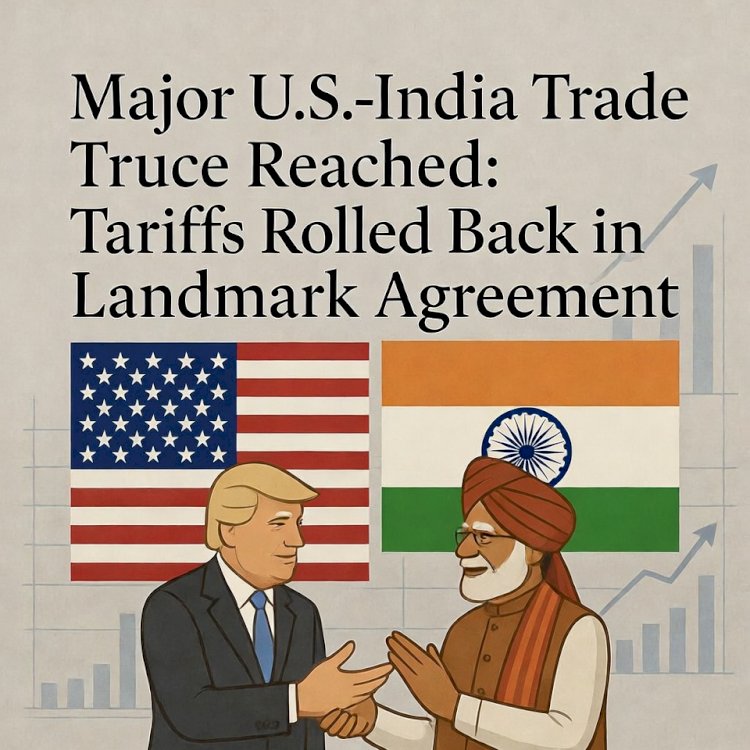
Major U.S.-India Trade Truce Reached: Tariffs Rolled Back in Landmark Agreement
 content-team
February 03, 2026
The United States and India announced a comprehensive trade truce late Monday that ends years of escalating tariffs and retaliatory measures, marking one of the most significant bilateral economic breakthroughs since the two nations elevated their strategic partnership. The deal, finalized after months of intense negotiations, removes punitive duties on billions of dollars of goods, restores market access for key sectors, and establishes new frameworks for future cooperation on technology, critical minerals, and supply chain resilience.
President Donald Trump hailed the agreement as a "historic win for American workers and Indian businesses," while Indian Prime Minister Narendra Modi described it as "a new chapter of trust and mutual prosperity" between the world's two largest democracies.
Core Elements of the Truce
The pact addresses long-standing irritants that had strained ties since 2019:
- The United States will immediately terminate additional tariffs imposed on Indian steel and aluminum under Section 232 national security provisions.
- India agrees to drop its retaliatory tariffs on 28 U.S. products, including almonds, apples, walnuts, chickpeas, and certain motorcycles and automobiles.
- Both countries commit to restoring Most Favored Nation treatment on a range of goods previously subject to punitive duties.
- A new bilateral working group will be established to resolve remaining market access issues, particularly in agriculture, dairy, medical devices, and digital trade.
- The agreement includes side letters on intellectual property protections, data localization rules, and cooperation in critical minerals and semiconductors.
The truce covers approximately 23 billion dollars in annual bilateral trade affected by the previous tariff actions. Officials estimate the deal will boost two-way commerce by at least 15 percent over the next three years.
Path to Resolution
Tensions had simmered since 2019 when India revoked the United States' Generalized System of Preferences status and the Trump administration responded with steel and aluminum tariffs. Subsequent rounds saw India impose countermeasures and both sides file complaints at the World Trade Organization.
Negotiations accelerated after President Trump's return to office, with high-level talks led by U.S. Trade Representative Jamieson Greer and Indian Commerce Minister Piyush Goyal. A breakthrough occurred during the recent visit of Indian External Affairs Minister S. Jaishankar to Washington, where both sides agreed to a comprehensive package rather than incremental fixes.
The agreement also builds on existing mechanisms such as the U.S.-India Trade Policy Forum and the Initiative on Critical and Emerging Technology (iCET), aligning trade normalization with broader strategic convergence on defense, semiconductors, and clean energy.
Immediate Market and Industry Reactions
U.S. agricultural exporters, particularly almond and apple growers in California, welcomed the removal of Indian retaliatory tariffs that had cost hundreds of millions in lost sales. Indian pharmaceutical companies and information technology firms expressed relief at restored predictability in market access.
Wall Street and Indian stock exchanges reacted positively, with gains in sectors most directly affected by the truce. The U.S. dollar softened slightly against the rupee in early Asian trading.
Broader Strategic Implications
Beyond economics, the deal reinforces the deepening U.S.-India strategic alignment amid shared concerns over supply chain vulnerabilities and regional security dynamics. Senior administration officials described the truce as "economic statecraft" that complements defense cooperation through the Quad and technology partnerships under iCET.
Analysts note the timing aligns with U.S. efforts to diversify supply chains away from single-country dependence and India's push to position itself as a global manufacturing hub under the "Make in India" initiative.
While some outstanding issues remain, including certain agricultural market access barriers and digital trade regulations, both governments committed to continued dialogue through the new working group. The agreement takes immediate effect, with full tariff rollbacks scheduled to complete within 90 days.
The U.S.-India trade truce represents a pragmatic reset in one of the world's most important bilateral economic relationships, clearing obstacles that had hindered deeper integration and setting the stage for expanded cooperation across multiple domains in the years ahead.