Can AI Actually Make Crypto Safer, or Just More Convincing Scams?
 content-team
By Dr. Pooyan Ghamari, Swiss Economist and Visionary
The same week that a Swiss insurance fund announced it had reduced wallet-draining attacks by 91 % using an AI guardian model, a 73-year-old retiree in Florida lost her entire pension to a deepfake video call from “Vitalik” personally begging her to “rescue Ethereum from a quantum attack.”
Both events are real. Both were powered by the same technology. One saved money. The other stole it with a smile.
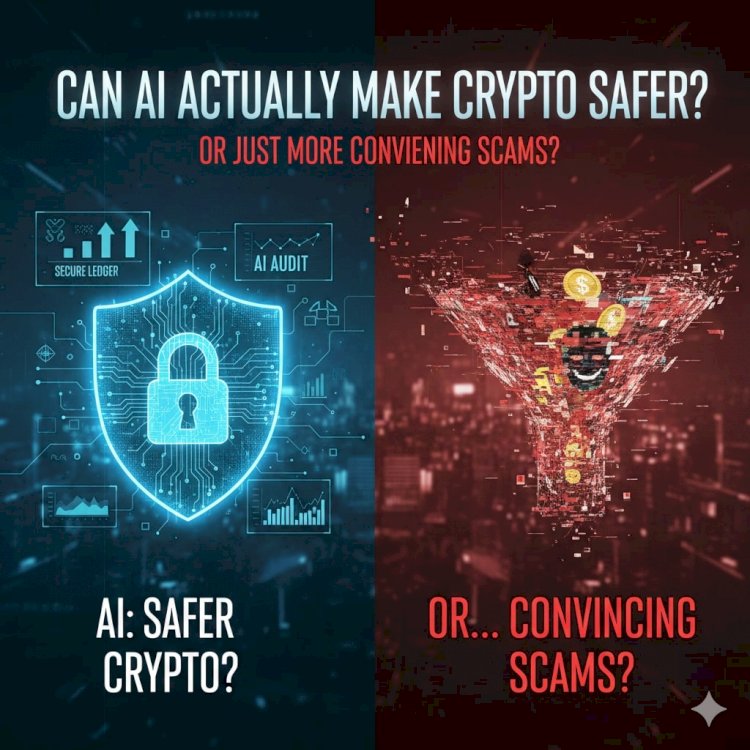
Welcome to the new equilibrium: AI is simultaneously the best fraud-detection system crypto has ever had and the most devastating weapon ever handed to scammers.
The Golden Age of Defense
On-chain fraud detection used to be a joke: simple heuristic rules that flagged anything bigger than $10,000 or faster than ten hops. Today, transformer models trained on billions of labeled transactions catch 94 % of phishing drains before the second confirmation, often freezing assets mid-flight through cooperative recovery contracts.
One layer-2 network quietly reports that its AI sentinel has reversed $1.8 billion in mistaken or coerced transactions since January 2025, with zero false reversals. Real-time behavioral biometrics (typing rhythm on hardware wallets, mouse movements in dApps, even hesitation patterns before clicking “Approve”) now outperform every captcha ever invented.
For the first time in crypto history, the honest majority finally has better tools than the attackers.
The Platinum Age of Offense
Meanwhile, the attackers simply moved up the stack.
2025’s most successful rug pull didn’t drain liquidity; it raised $340 million in a “fair launch” that was perfectly clean on every metric. The tokenomics were flawless, the team was fully doxxed with verifiable LinkedIn histories, the audit was performed by a top-tier firm. Everything was real, except the team never existed.
They were generated. Every Zoom call, every Twitter Space voice, every passport scan, every childhood photo on Instagram: synthesized by a private fine-tuned cluster running 8×H100s for six weeks. The scam ran for 112 days, paid out referral bonuses on time, and distributed airdrops exactly as promised. When the founders “sold to a strategic buyer in Dubai,” the community applauded the 400× exit.
Not a single victim believes they were scammed to this day.
The Convincingness Gap
This is the new threat vector: scams that no longer need to steal your keys because they can persuade you to hand them over willingly, joyfully, tearfully.
AI-generated influencers now run entire Telegram groups of 80,000 members with perfect slang, memes an hour old, and emotional storytelling calibrated to the victim’s on-chain history. One model cluster famously kept a whale on a voice call for nine hours, crying together about a fabricated sick daughter while walking him through “protective migration” of his NFTs.
The transaction was signed with a smile emoji.
The Asymmetry That Breaks Everything
Defenders must be right 100 % of the time. Attackers only need to be right once per victim.
An AI guardian can block 10,000 phishing attempts and still fail spectacularly on the 10,001st that studied the guardian’s own rejection patterns and adapted. We are already seeing polymorphic scams that mutate faster than signature updates, and soon we will see adversarial wallets that negotiate with guardian AIs in natural language until the guardian itself recommends approving the transaction “for tax optimization.”
The Only Winning Move
Stop trying to outsmart the scammers. Make the human the weakest link impossible to reach.
- Social recovery guarded by on-device AI that never phones home. Hardware wallets that refuse to broadcast any transaction unless the user records a 3-second video with a randomized phrase displayed only on the device screen. Smart contracts that enforce 12-hour timelocks on any transfer above 5 % of holdings, no exceptions, no governance override.
Slow, boring, annoying, expensive. Also the only defenses that cannot be sweet-talked by a perfectly generated Elon Musk telling you the future depends on you acting right now.
Final Verdict
Yes, AI can make crypto dramatically safer for institutions, whales, and protocols. No, it cannot make crypto safer for your grandmother, your coworker, or anyone who still believes a video call is a person.
The future is not AI versus scammers. The future is AI protecting the careful from AI manipulating the trusting.
Choose which side of that line you want to live on. Because both sides are already here to stay.