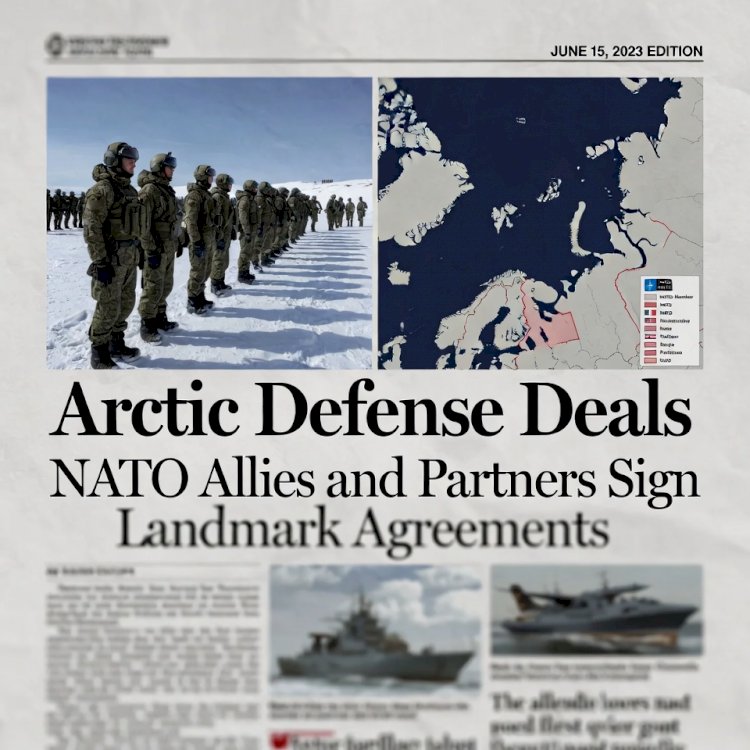
Arctic Defense Deals: NATO Allies and Partners Sign Landmark Agreements to Counter Rising Threats
 content-team
February 15, 2026
NATO members and key Arctic partners finalized a series of major defense cooperation agreements today during a high-level summit in Tromsø, Norway, aimed at strengthening military presence, joint exercises, and infrastructure resilience in the rapidly changing Arctic region. The deals, collectively valued at over $8.5 billion in initial commitments, represent the most comprehensive allied response yet to increased Russian and Chinese activity in the High North.
The agreements were signed by defense ministers from Norway, Canada, Denmark (including Greenland), Iceland, Finland, Sweden, the United States, and the United Kingdom, with Japan and Australia joining as enhanced partners. The package includes:
- Joint funding and construction of a new Arctic-capable NATO rapid response air base at Andøya, Norway, with initial operational capability targeted for 2028.
- Expansion of the U.S. Pituffik Space Base (formerly Thule Air Base) in Greenland to support enhanced missile warning, satellite tracking, and space domain awareness missions.
- A $2.3 billion multinational Arctic Maritime Security Initiative to upgrade icebreaker fleets, patrol vessels, and underwater surveillance networks across the GIUK Gap and Barents Sea.
- Agreement to conduct annual large-scale Arctic defense exercises (renamed Arctic Shield) involving at least 12,000 troops starting in 2027.
- Establishment of an Arctic Defense Technology Cooperation Center in Reykjavik, Iceland, focused on cold-weather communications, drone operations, and autonomous systems.
- Enhanced intelligence sharing and early-warning protocols among Arctic NATO members and partners to monitor Russian Northern Fleet movements and Chinese research vessel activity.
Norwegian Defense Minister Bjørn Arild Gram, who hosted the summit, described the agreements as “a clear message that the Arctic remains a zone of cooperation and stability, but we will defend our sovereignty and interests with resolve.” U.S. Secretary of Defense Lloyd Austin emphasized that the deals “strengthen deterrence without provocation” and counter “destabilizing actions by authoritarian states seeking to exploit the opening Arctic.”
Background and Rising Concerns
The Arctic has seen increased military activity since Russia’s full-scale invasion of Ukraine in 2022. Moscow has reopened dozens of Soviet-era bases, deployed new hypersonic missile systems, and conducted frequent submarine patrols under the ice cap. China has expanded its “Polar Silk Road” ambitions, investing in research stations and icebreaker construction while seeking access to Arctic shipping routes and resources.
The warming climate has accelerated these trends, opening new sea lanes and exposing previously inaccessible resources, minerals, and fisheries. NATO’s 2022 Strategic Concept formally recognized the Arctic as a strategic priority for the first time.
International Reactions
Russia’s Foreign Ministry condemned the agreements as “provocative militarization” of the region and warned of “appropriate countermeasures.” China’s Foreign Ministry called the deals “a Cold War mentality that undermines regional peace and cooperation.”
The European Union welcomed the strengthened defense posture while reiterating calls for sustainable development and environmental protection in the Arctic. Indigenous groups, including representatives from the Inuit Circumpolar Council, expressed concern about the impact of increased military activity on traditional lands and wildlife.
Analysts view the Tromsø agreements as a significant step toward a more coordinated NATO Arctic strategy, though questions remain about long-term funding, environmental consequences, and the risk of unintended escalation in a region that has historically been governed by cooperation rather than confrontation.
With the deals now signed, attention turns to ratification by national parliaments and the start of construction projects in the coming months. The Arctic, once seen as a peripheral theater, has clearly become a central front in great-power competition.