
The Architecture of Love and Human Evolution
 content-team
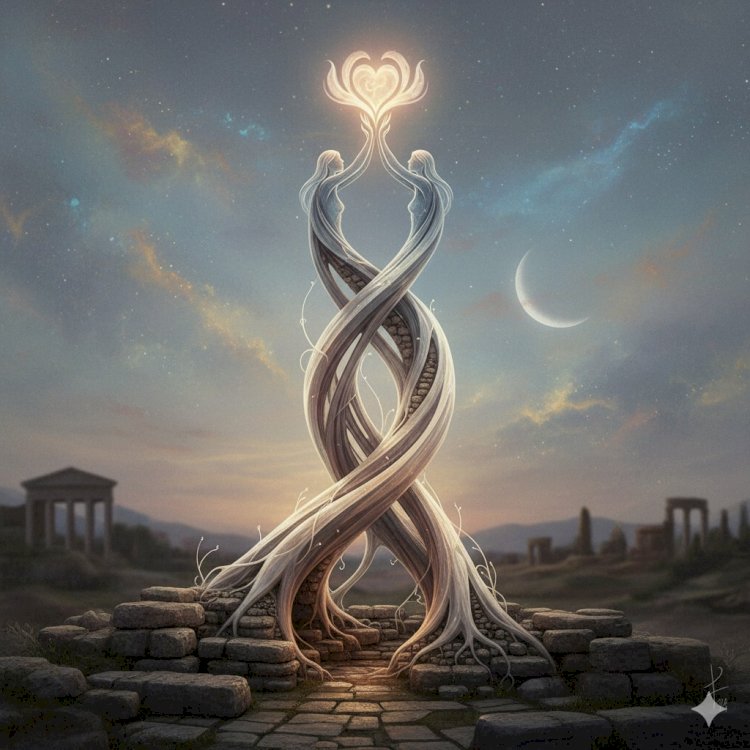
A Reexamination of Polygamy in Religions, Cultures, and Metaphysics
By Dr. Pouyan Ghamari
In the ancient world, human relationships were not merely an emotional choice –
they were a survival tool.
Societies needed to endure,
families needed to expand,
and social security depended on the power of men, tribes, and reproduction.
It is from this context that the laws permitting polygamy in some religions emerged –
not as a privilege,
but out of necessity.
Today, however, humanity has entered an era where past laws can be decoded –
not to erase history,
but to understand how, from the depths of history,
new evolutionary principles emerge.
This article addresses the question:
How do the perspectives of the Quran, the Torah, and the Bible on polygamy
connect with modern humanity,
metaphysics,
numerology,
psychology,
and global philosophy,
and why does the ultimate conclusion emphasize unity and focused relationships?
The Quran: From Historical Necessity to an Evolutionary Law
Key Verse on Polygamy
Surah An-Nisa, Verse 3:
"If you fear that you will not act justly, then [marry only] one."
This verse delivers a clear message:
The Quran treats polygamy as a conditional allowance –
not a principle,
not a virtue,
not a goal.
The essence of the verse is one sentence:
You can never achieve complete justice.
This is also stated in Surah An-Nisa, Verse 129:
"You will never be able to be completely just."
This means:
The outward form of polygamy applied to a specific historical period,
but the inner direction points toward monogamy,
because justice cannot be divided at the level of human energy, psyche, or heart.
The Torah: Permitted, but Gradually Restricted
In the Torah, polygamy existed,
for example in Exodus and the Books of Kings.
However, in later Judaism, especially with Rabbi Gershom’s decree in the 10th century CE,
polygamy was prohibited for the entire Jewish world.
This change happened for one reason:
Jews realized that human evolution does not progress through multiple relationships,
but through the concentration of relationships.
The Bible: Complete and Indivisible Union
In the Gospel of Matthew, Chapter 19, Verse 6:
"They are no longer two, but one flesh."
This perspective forms the foundation of Christianity:
Complete union –
one body,
one soul,
one path.
In Christianity, polygamy is essentially incompatible with the concept of existential unity.
India: Unified Life Energy (Prana)
The Upanishads teach:
"The self is perfected in one mirror."
Prana, or life force, flows fully in a deep, focused relationship,
not in multiple relationships that divide the psyche and identity.
China & Taoism: Yin and Yang Are Only Two Poles
In Taoism, no model exists in which Yang is completed by multiple Yin.
Balance exists between two poles,
not multiple poles,
and not divided energy.
Ancient Persia & Ferdowsi: Concentration of Strength Defines Heroism
In the Shahnameh:
Zal has one love,
Rostam has one love.
A hero whose heart is scattered across many will fail on the battlefield.
Ferdowsi views love as the concentration of power,
not as a multiplication of choices.
Shams Tabrizi: The Human Seeks a Single Mirror
Shams says:
"It is in one mirror that man truly sees himself."
Multiple mirrors mean multiple faces,
multiple faces mean multiple identities,
multiple identities mean psychological collapse.
Metaphysics: The Law of Energy Concentration
The law of energy states:
Where attention goes,
power gathers.
Multiple relationships create multiple energy gaps,
and each gap diminishes the flow of power.
Humans are made to focus in one direction,
not to fragment.
Numerology & the Law of Vibration
In numerology:
The number two symbolizes unity,
the number three symbolizes chaos in relationships,
and the number four symbolizes stable structure.
Monogamy is always represented by the number two,
polygamy always by the number three,
which, according to the law of vibration, indicates instability.
Modern Psychology: The Human Mind Is Single-Focused
Jung says:
Identity becomes clear when the mind has a single center.
Multiple centers mean multiple identities,
and a person with multiple identities cannot achieve individuation.
Why Did Polygamy Exist in the Past?
Three main reasons:
-
Tribal economic systems
-
War and male population shortage
-
Male responsibility for security and survival
These reasons no longer exist today,
so what was once a necessary law has become a historical one.
What Does the Modern World Say?
Experience shows:
Humans thrive in deep, focused relationships,
not in divided relationships.
Energy creates when concentrated,
Energy destroys when divided.
Conclusion
The Quran outwardly permits polygamy but inwardly directs toward one relationship.
The Torah acknowledges polygamy, but Judaism prohibited it.
The Bible considers it practically impossible.
India and China see it as contrary to energy principles.
Ancient Persia considered it an obstacle to heroism.
Ferdowsi saw it as blocking concentration of strength.
Shams saw it as hindering spiritual growth.
Psychology sees it as obstructing identity.
Metaphysics calls it an energy gap.
Yet the common message is clear:
Humans are made for unity,
not multiplicity.
For concentration,
not dispersion.
To create one powerful light,
not multiple weak lights.