Eurovision Boycott Bombshell: Spain, Ireland, Netherlands, and Slovenia Pull Out Over Israel's Participation
 content-team
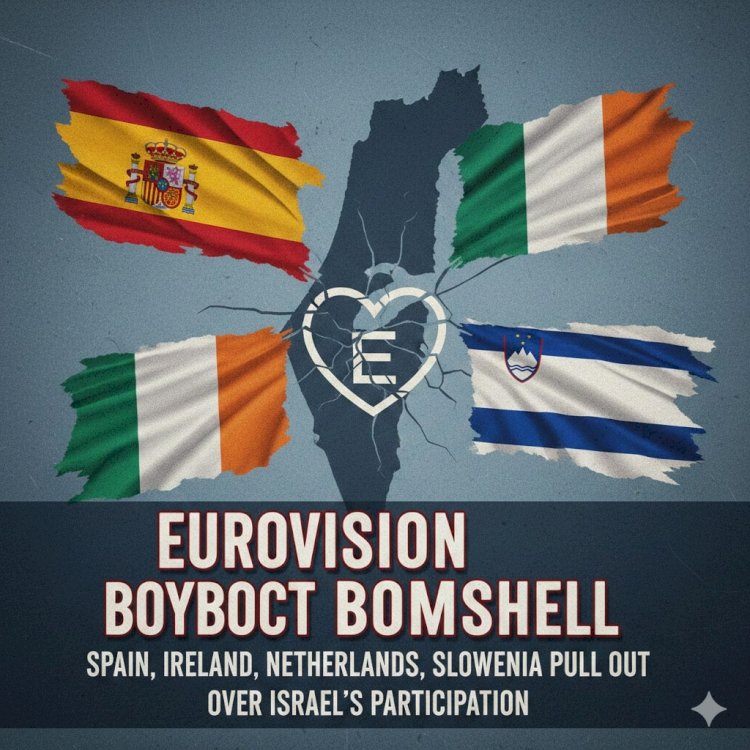
The glitzy world of sequins, synth-pop anthems, and continental camaraderie has been plunged into crisis, as four major European broadcasters announced on December 4, 2025, their withdrawal from the 2026 Eurovision Song Contest in protest over Israel's continued inclusion. Spain, Ireland, the Netherlands, and Slovenia cited the ongoing humanitarian crisis in Gaza and Israel's alleged politicization of the event as reasons for their boycott, marking the most significant schism in the competition's 70-year history. With the European Broadcasting Union (EBU) opting against a vote on Israel's eligibility at its Geneva assembly, the decision has sparked fears of a domino effect, potentially slashing the 2026 lineup in Vienna and threatening the contest's vaunted apolitical facade.
The Geneva Gambit: No Vote, Big Backlash
The rupture crystallized at the EBU's two-day general assembly in Geneva, where delegates from 50 broadcasters gathered to debate reforms amid mounting calls for Israel's exclusion. Israel's Kan broadcaster, a full EBU member since 1973 despite the country's Middle Eastern geography, faced scrutiny over its 2025 performance—finishing second in the public televote but lower with juries—amid accusations of government-backed voting campaigns. Pro-boycott voices, led by Spain's RTVE and Ireland's RTÉ, demanded a ballot on Kan's status, arguing the Gaza war's toll—over 43,000 Palestinian deaths per health ministry figures—rendered participation "unconscionable."
EBU chief executive Noel Curran, in a tense Thursday address, rebuffed the vote, citing the organization's charter that bars exclusion on political grounds. "Eurovision is a cultural celebration, not a geopolitical arena," he insisted, announcing instead voting tweaks: capping public votes at 10 per method to curb "disproportionate influence" and anonymizing jury tallies. The compromise satisfied some—like Germany's SWR and the UK's BBC—but ignited fury among others. By evening, the quartet issued a joint statement: "We supported EBU reforms but believe ongoing dialogue on credibility is essential. Israel's participation remains incompatible with our values of peace and human rights."
Spain's RTVE president José Pablo López was blunt: "Eurovision is no longer neutral—it's fractured by geopolitics." Ireland's RTÉ echoed: "The appalling loss of lives in Gaza makes our involvement untenable." The Netherlands' AVROTROS decried "humanitarian suffering," while Slovenia's RTV Slovenia reaffirmed its stance: "We will not compete if Israel does, guided by equality among nations."
Historical Heartbreak: Echoes of Past Protests
Eurovision's boycott blues aren't new—the contest has weathered political tempests since its 1956 Stockholm debut. Austria skipped Spain's 1969 edition in protest against Franco's dictatorship; Greece boycotted 1975's Stockholm show amid Cyprus tensions. Jordan pulled from 1973's Luxembourg final over Israel's entry, and Morocco's 1980 one-off fizzled after Luxembourg favored Israel. Lebanon's 2005 flirtation ended in withdrawal when forced to air the full show, including Israeli acts.
Yet this quartet's clout is colossal. Spain, a "Big Five" financial pillar alongside France, Germany, Italy, and the UK, guarantees automatic finals spots and hefty funding. Ireland boasts seven wins—the most with Sweden—and cultural cachet; the Netherlands, a 1956 founder, brings innovation; Slovenia symbolizes EU expansion. Their absence guts the 2026 field—potentially 43 entrants down to 39—slashing revenue from ticket sales, broadcasts, and sponsorships. Austria's ORF, the Vienna host, shrugged off the hit: "The show goes on—we'll adapt without suffering."
Iceland's RÚV, which threatened boycott earlier, deferred to its board meeting next week. Belgium's RTBF, slated to cover 2026, weighs its stance, while Finland, Norway, Denmark, and Sweden affirmed participation, praising voting fixes. Israel's Kan CEO Golan Yochpaz decried the pullouts as a "cultural boycott" that "may start with us but won't end there," thanking backers like Germany, whose culture minister Wolfram Weimer thundered: "Eurovision without Israel is unthinkable."
Gaza's Long Shadow: From 2024 Protests to 2026 Pullouts
The schism stems from Israel's 2024 Basel entry—Eden Golan's "Hurricane," accused of glorifying war—sparking arena walkouts and "Free Palestine" chants. 2025's Yuval Raphael fared better, second in televotes but jury-scrutinized, amid claims of Israeli ad blitzes. Protests swelled: Spain's RTVE faced Madrid demos; Ireland's RTÉ drew Dublin ire. The EBU's reforms—limiting public votes, anonymizing juries—aimed to "curb interference," but boycotters deemed them "insufficient," demanding Israel's ouster.
Israeli President Isaac Herzog hailed the EBU nod as "solidarity through culture," while Foreign Minister Gideon Saar shamed the quitters: "Ashamed of nations abandoning values for politics." Spain's Culture Minister Ernest Urtasun backed the boycott: "You can't whitewash genocide in Gaza." RTÉ's Neil O'Gorman added: "Ireland's participation remains unconscionable."
Vienna's Veiled Victory? EBU's Tightrope and a Fractured Fest
For 2026's 70th anniversary—slated for May 13-17 at Vienna's Wiener Stadthalle—the boycott bites deep. ORF's Alexander Wrabetz vowed resilience: "We'll deliver a spectacular show; the spirit endures." Yet financial fog looms: the Big Five's €25 million kitty shrinks without Spain's share, risking sponsor flight. Curran, EBU's helmsman, urged unity: "Eurovision bridges divides—let's not burn the bridge."
Critics like Dean Vuletic, Eurovision historian, see watershed: "A turning point—first mass pullout since Franco's era." Duncan Wheeler, Leeds University Spanish studies chair, notes irony: "Spain boycotts now, but entered post-Franco ostracism to join the club." Morocco and Lebanon's de facto boycotts since 1980 underscore Israel's long shadow.
As December dawns, the EBU eyes contingencies—perhaps a "unity semi-final" sans boycotters. For fans dreaming of sequins over schisms, the rift rends the rainbow: will Vienna's velvet rope hold, or fray? Eurovision's song remains the same—but its chorus grows hoarse.